Mohammed Ahsan & Co. is the sole local service provider listed in the referenced ICAP List of ISQM 1 Service Providers. In the September 2025 version of that list, published by the Institute of Chartered Accountants of Pakistan (ICAP) on its ISQM Knowledge Hub, our firm appears as the only entry under “Local Service Providers”, under the name “Muhammad Ahsan & Co. Chartered Accountants”, for four ISQM-related services.
This matters because ISQM 1 implementation in Pakistan is now a live obligation for most audit firms. ISQM 1 requires every firm to design, operate and evaluate its own risk-based system of quality management (SOQM). Many firms — particularly small and medium-sized practices — benefit from structured technical support to update policies, train their people, perform objective reviews and complete the annual evaluation.
This article first explains our firm’s documented position in ICAP’s list and the four services it records. It then provides a complete practical guide to ISQM 1 for Pakistani audit firms, including ICAP’s latest deadlines, the eight components, risk registers, monitoring, root cause analysis and the annual evaluation.
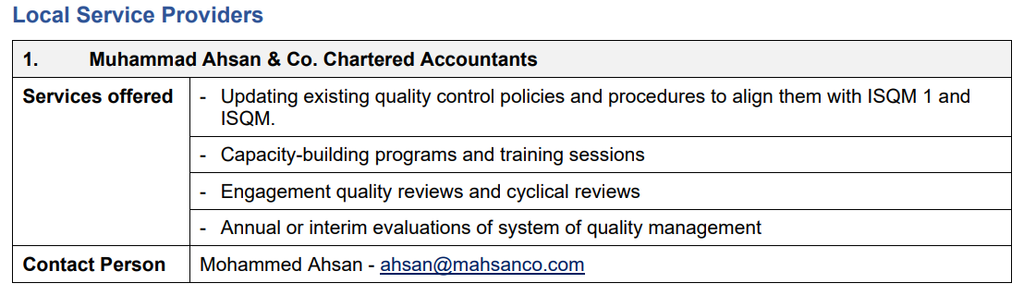
To help audit firms comply with ISQM 1, ICAP’s Auditing Standards & Ethics Board (ASEB) compiled the List of ISQM 1 Service Providers and announced it through ASEB Circular 06/2025. The list is published on ICAP’s ISQM Knowledge Hub.
The document is divided into two sections. International Service Providers contains nine entries offering ISQM manuals, toolkits, software, training and reviews. Local Service Providers, on page 9, contains a single entry: Muhammad Ahsan & Co. Chartered Accountants. Our website branding is Mohammed Ahsan & Co. — both spellings refer to the same firm, and the ICAP entry names Mohammed Ahsan as the contact person with the email address ahsan@mahsanco.com.
| Firm (as listed by ICAP) | Muhammad Ahsan & Co. Chartered Accountants |
| Website branding | Mohammed Ahsan & Co., Chartered Accountants |
| Listing category | Local Service Providers — the only entry in this section of the referenced version |
| Document | ICAP, List of ISQM 1 Service Providers, page 9 of 9 |
| Version referenced | September 2025 updated version referenced in this article |
| Announced by | ICAP ASEB Circular 06/2025 |
| Services listed | Four (see below) |
| Contact listed | Mohammed Ahsan — ahsan@mahsanco.com |
The four services recorded against our firm in the ICAP list are:
Accuracy matters in professional communication, so the listing should be read for what it is:
International manuals and software can be valuable, but a Pakistani audit firm’s system must also reflect Pakistani conditions. A local ISQM 1 service provider in Pakistan can relate the standard directly to ICAP’s circulars and implementation dates, the company size categories of the Companies Act, 2017, the ICAP Code of Ethics, ICAP’s Quality Control Review (QCR) programme and Audit Oversight Board expectations for firms auditing public interest companies. Local support can also be delivered on site, in the firm’s working language, and within the realities of Pakistan’s peak reporting and tax seasons.
The following sections explain each of the four services recorded in ICAP’s list. In every case, the client firm keeps ultimate responsibility for its system of quality management; our role is to provide technical support, objective challenge and structured documentation. Details of our ISQM 1 implementation services are also available on our service page.
What it involves: a gap analysis of the firm’s existing ISQC 1 manual against ISQM 1, followed by restructuring policies around the eight ISQM 1 components, establishing quality objectives, identifying and assessing quality risks, and designing responses.
Who may need it: firms still operating an ISQC 1-based manual, firms that bought a generic template that has not been tailored, and firms auditing only SMCs that need to confirm their applicable implementation date against current ICAP guidance.
Common challenges: relabelling old policies as “responses” without a genuine risk assessment; risks that are not linked to objectives; and policies written for a larger firm that do not match how the practice actually works.
Documentation and processes: an updated quality management manual, a quality risk register, a responsibilities matrix, and supporting forms such as acceptance checklists, independence declarations and consultation records.
How technical support helps: an experienced reviewer can identify gaps quickly, apply ICAP’s Guide and Toolkit in context, and keep documentation proportionate to the firm’s size.
Client firm’s responsibility: leadership must own the risk assessment, approve the policies, and ensure responses are implemented and operate in practice.
What it involves: ISQM 1 training in Pakistan tailored to different roles — partners and leadership on governance and the annual evaluation; quality managers on risk assessment, monitoring and root cause analysis; and engagement teams on how firm-level responses affect their daily work.
Who may need it: firms implementing ISQM 1 for the first time, firms whose staff turnover has diluted understanding, and firms preparing for a quality review.
Common challenges: generic sessions that do not connect to the firm’s own policies, limited partner attendance, and no record of who was trained on what.
Documentation and processes: training needs analysis, session materials, attendance records and CPD logs that link to the firm’s “resources” responses.
How technical support helps: practical, case-based professional training using Pakistani scenarios helps teams understand why each policy exists, not only what it says.
Client firm’s responsibility: the firm decides who must be trained, monitors completion, and assesses whether the training has improved quality.
What it involves: engagement quality reviews (EQRs) performed in accordance with ISQM 2 before the engagement report is dated, and cyclical reviews (inspections) of completed engagements as part of the firm’s monitoring activities under ISQM 1.
Who may need it: smaller firms and sole practitioners that do not have an eligible, objective individual internally; firms that audit listed entities or other engagements requiring EQR; and firms needing independent inspection of partners’ files.
Common challenges: reviewers who lack objectivity because they worked on the engagement, EQRs completed after the report date, and inspections that record findings but never feed into root cause analysis.
Documentation and processes: EQR appointment and eligibility records, EQR checklists and sign-offs, an inspection plan, inspection reports and a findings log.
How technical support helps: an external reviewer can provide the objectivity and competence that ISQM 1 and ISQM 2 require, drawing on our own audit practice. Objectivity must be considered before acceptance — for example, the person who helped design a firm’s policies should not be the same person who inspects whether those policies operate.
Client firm’s responsibility: the engagement partner remains responsible for the engagement and its report, and the firm remains responsible for evaluating findings and taking remedial action.
What it involves: supporting leadership in the ISQM 1 annual evaluation in Pakistan — collating monitoring results, assessing the severity and pervasiveness of deficiencies, reviewing remediation progress, and documenting the basis for the conclusion. An interim evaluation can be performed before the first annual evaluation to test readiness.
Who may need it: firms approaching their first annual evaluation, firms whose previous evaluation lacked supporting evidence, and firms preparing for QCR.
Common challenges: treating the evaluation as a one-page sign-off, concluding without monitoring evidence, and failing to communicate the conclusion within the firm.
Documentation and processes: a monitoring summary, a deficiency and remediation tracker, an evaluation memorandum and evidence of communication to personnel.
How technical support helps: a structured evaluation framework and an objective review of the evidence make the conclusion more robust and easier to defend.
Client firm’s responsibility: ISQM 1 requires the individual(s) with ultimate responsibility and accountability for the SOQM to perform the evaluation and reach the conclusion. That responsibility cannot be outsourced.
ISQM 1, Quality Management for Firms that Perform Audits or Reviews of Financial Statements, or Other Assurance or Related Services Engagements, was issued by the International Auditing and Assurance Standards Board (IAASB) in December 2020, with an international effective date of 15 December 2022.
ISQM 1 quality management applies at firm level. Every firm that performs audits, reviews, other assurance or related services engagements — from a sole practitioner to a multi-office practice — must operate a system that provides reasonable assurance that:
The key shift is from “Do we have the required policies?” to “What could go wrong with quality in our firm, and are our responses working?” A downloaded manual is not, on its own, a system of quality management.
ISQM 1 supersedes ISQC 1. Familiar topics remain, but the architecture is different.
| Area | ISQC 1 (superseded) | ISQM 1 |
|---|---|---|
| Overall approach | Policies and procedures for each element of quality control | Risk-based system of quality management tailored to the firm |
| Structure | Six elements | Eight interconnected components |
| Risk assessment | No formal firm-level risk assessment process | Quality objectives, quality risks and responses must be established |
| Leadership | Leadership responsibilities for quality | Ultimate and operational responsibility must be assigned; leadership is subject to performance evaluation |
| Resources | Mainly human resources | Human, technological and intellectual resources, including service providers |
| Information and communication | Not a separate element | Separate component, including certain external communication |
| Monitoring | Monitoring including cyclical inspection of completed engagements | Monitoring of the whole system, evaluation of findings, root cause analysis and remediation |
| Annual conclusion | No formal annual evaluation conclusion | Leadership must evaluate and conclude on the SOQM at least annually |
| Engagement quality review | Addressed within ISQC 1 and ISA 220 | Moved to a separate standard, ISQM 2 |
ICAP adopted ISQM 1, ISQM 2 and ISA 220 (Revised) through ICAP Circular No. 06/2022 dated 25 November 2022, superseding ISQC 1 and the previous ISA 220. Pakistan set phased dates rather than using the IAASB’s international date.
| Category of audit firm | SOQM designed and implemented by | First evaluation of the SOQM | ICAP reference |
|---|---|---|---|
| Firms auditing public interest companies (PICs) | 15 December 2023 | Within one year, i.e. by 15 December 2024 | ASEB Circular 04/2025 |
| Firms auditing companies other than PICs (for example, large-sized companies) | 31 December 2024, as stated in ASEB Circular 04/2025* | Within one year; Circular 04/2025 refers to 15 December 2025 | ASEB Circular 04/2025 |
| Firms auditing only small and medium-sized companies (SMCs) and not PICs or large-sized companies | 1 July 2026 under ASEB Circular 07/2025; firms should confirm whether any later circular has amended this date | Confirm the first evaluation date against the currently applicable ICAP circulars | ASEB Circular 07/2025 |
*Some earlier ICAP material refers to 15 December 2024 for this category. Firms should confirm the date applicable to them against ICAP Circular No. 06/2022 and current ASEB communications.
Deadline verification note (October 2026): The official extension independently verified for this article is ASEB Circular 07/2025, which specified 1 July 2026 for eligible firms auditing exclusively small and medium-sized companies (and not PICs or large-sized companies). Before relying on any deadline, confirm whether ICAP has issued a later amendment. An additional October 2026 extension has not been independently substantiated for this article.
ASEB Circular 04/2025 also reminds firms that ISQM 1 requires them to assign ultimate responsibility and accountability for the SOQM to the chief executive officer or managing partner (or equivalent), operational responsibility for the SOQM, and operational responsibility for independence and for the monitoring and remediation process.
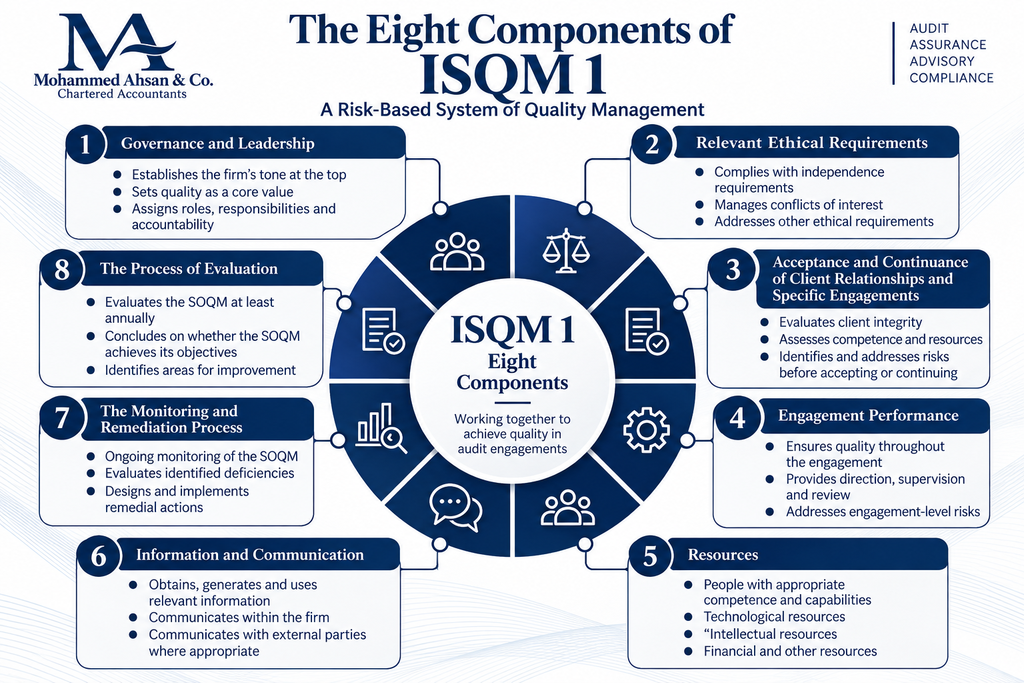
The components are interconnected: the risk assessment process drives the design of the others, and monitoring and remediation feeds information back into the whole system.
| # | Component | What it covers | Practical example |
|---|---|---|---|
| 1 | The firm’s risk assessment process | Establishing quality objectives, identifying and assessing quality risks, and designing responses | A risk register linking each objective to risks and responses |
| 2 | Governance and leadership | Culture, leadership accountability, organisational structure and resource allocation | Quality-related goals in partner performance evaluations |
| 3 | Relevant ethical requirements | Independence and other ethical requirements, including the ICAP Code of Ethics | Annual independence confirmations from all relevant personnel |
| 4 | Acceptance and continuance | Decisions on client relationships and specific engagements | Acceptance checklist covering integrity, competence and team capacity |
| 5 | Engagement performance | Direction, supervision, review, consultation, differences of opinion and documentation | Mandatory consultation on going concern and complex IFRS matters |
| 6 | Resources | Human, technological and intellectual resources, including service providers | Approved audit software templates and a CPD plan for each grade |
| 7 | Information and communication | Obtaining, generating and communicating information about the SOQM | Communication with those charged with governance of listed audit clients |
| 8 | Monitoring and remediation process | Monitoring, evaluation of findings, root cause analysis and remediation | Inspection of completed engagements and a tracked remediation log |
ISQM 1 does not prescribe a single method, but most successful implementations follow this sequence.
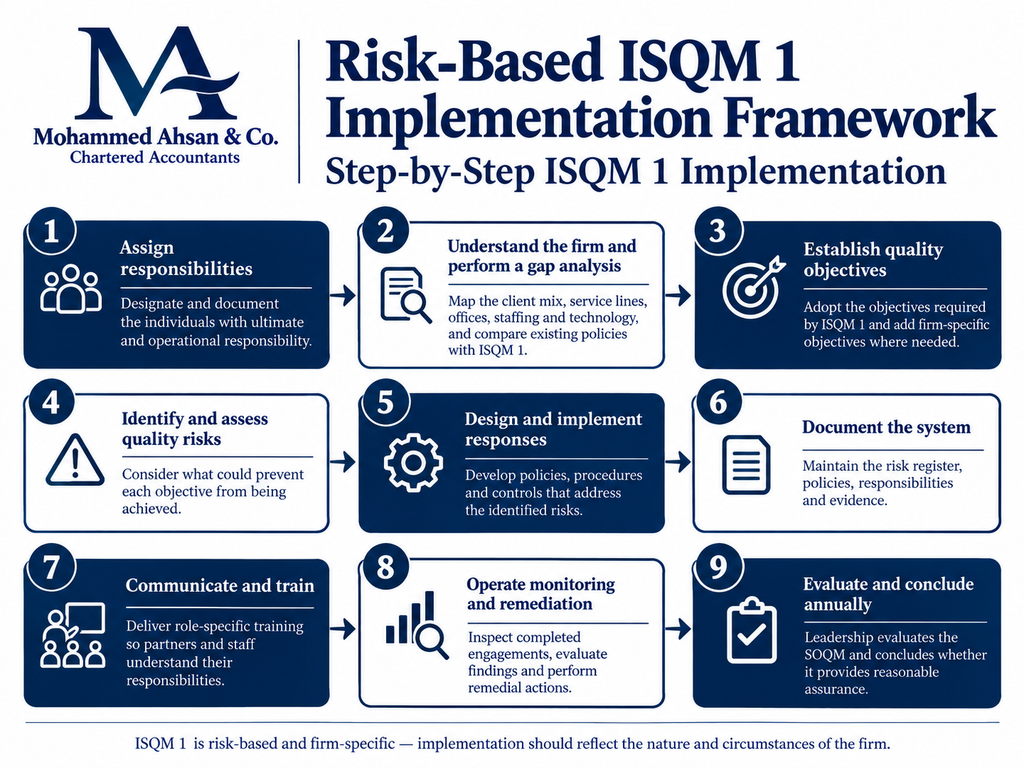
ICAP’s ISQM Guide and Toolkit and the IAASB’s ISQM 1 First-Time Implementation Guide are useful starting points, but neither replaces a firm’s own tailored risk assessment.
Quality objectives are the desired outcomes for each component. ISQM 1 specifies objectives every firm must establish — for example, that the firm demonstrates a commitment to quality through its culture, or that personnel fulfil relevant ethical requirements. Firms may add further objectives where their circumstances require.
A quality risk is one that has a reasonable possibility of occurring and, individually or in combination with other risks, of adversely affecting the achievement of one or more quality objectives. Firms consider the conditions, events, circumstances, actions or inactions that could affect their objectives, then judge which risks meet this threshold.
Responses are the policies and procedures that address assessed quality risks. Beyond firm-specific responses, ISQM 1 requires every firm to have responses that include:
A quality risk register is the central working document of the SOQM. The illustrative extract below shows how a Pakistani audit firm might record risks, assessments, responses, owners and evidence. Each firm must assess its own risks.
| Ref | Component and quality risk | Assessment (illustrative) | Response | Owner | Evidence of operation |
|---|---|---|---|---|---|
| GL-1 | Governance: fee and recovery targets lead partners to prioritise commercial considerations over quality | Higher | Quality measures in partner evaluations; leadership approval of significant fee reductions | Managing partner | Signed partner evaluations; fee approval log |
| ET-1 | Ethics: bookkeeping or tax services to an audit client create an unidentified self-review threat | Higher | Pre-approval of non-assurance services; independence register; annual confirmations | Independence partner | Approval forms; signed confirmations |
| AC-1 | Acceptance: engagements accepted without assessing staff capacity around peak deadlines | Moderate | Capacity assessment in the acceptance checklist | Designated partner | Completed checklists |
| EP-1 | Engagement performance: deadline pressure reduces partner review of high-risk areas | Higher | Milestone reviews; partner sign-off on significant risks before the report date | Engagement partners | Review notes and sign-off dates |
| RS-1 | Resources: turnover of trainees and semi-qualified staff disrupts continuity | Moderate | Training plan, CPD tracking, documented handovers | HR / quality manager | Training records; handover notes |
| IC-1 | Information: audit templates not updated for new or revised standards | Moderate | Template ownership, annual update cycle, version control | Technical manager | Template change log |
| MR-1 | Monitoring: inspections performed by individuals who are not sufficiently objective | Higher | Inspector rotation or a suitably qualified external reviewer | Monitoring partner | Inspection plan; reviewer independence declarations |
The monitoring and remediation process tells the firm whether its SOQM is working. Monitoring should combine ongoing and periodic activities and must include inspection of completed engagements, with the firm determining which engagements and engagement partners to select. Individuals performing monitoring must be competent, have sufficient time and be objective — they should not inspect an engagement on which they served as a team member or engagement quality reviewer.
Not every finding is a deficiency. The firm evaluates findings — from internal inspections, external reviews, complaints and network or service-provider information — to determine whether deficiencies exist, and assesses their severity and pervasiveness. Remedial actions must respond to root causes, and those responsible must evaluate whether the actions are appropriately designed, implemented and effective. ICAP’s ASEB Circular 13/2025 emphasises clear responsibilities and timelines for remediation, particularly for firms auditing PICs.
Root cause analysis (RCA) asks why a deficiency occurred, not just what went wrong. ASEB Circular 13/2025 encourages firms to set criteria for when RCA is required, particularly for recurring or significant findings. A practical RCA process:
For example, a missing going-concern assessment may trace not to one careless senior, but to a template that lacked the procedure, inadequate training, or unrealistic deadlines. Fixing only the individual file would leave the root cause in place.
At least annually, the individual(s) with ultimate responsibility and accountability must evaluate the SOQM, as at a point in time, and conclude one of the following:
For the second or third conclusion, the firm must take prompt and appropriate action and communicate the conclusion to engagement teams and other relevant individuals. The firm must also periodically evaluate the performance of individuals assigned ultimate and operational responsibility. A robust evaluation is supported by a signed memorandum, a monitoring summary, the status of remedial actions and the basis for the conclusion.
| Aspect | ISQM 1 | ISQM 2 | ISA 220 (Revised) |
|---|---|---|---|
| Level | Firm | Engagement quality review | Individual audit engagement |
| Main focus | Designing, implementing and operating the SOQM | Appointment, eligibility and performance of the engagement quality reviewer | The engagement partner’s responsibility for managing and achieving quality on the audit |
| Key responsibility | Firm leadership | Engagement quality reviewer, within the firm’s policies | Engagement partner and engagement team |
| Notable requirements | Risk assessment process, eight components, monitoring and annual evaluation | Reviewer objectivity and competence, including a two-year cooling-off period before a former engagement partner can act as reviewer | Sufficient and appropriate involvement of the engagement partner throughout the audit |
| Applies to | Firms performing audits, reviews, other assurance or related services engagements | Engagements for which an EQR is required under ISQM 1 | Audits of financial statements |
Firms should confirm the applicability dates of ISQM 2 and ISA 220 (Revised) in Pakistan against ICAP’s adoption and extension circulars.
ISQM 1 requires documentation of the SOQM that is sufficient to support a consistent understanding of the system by personnel, the consistent implementation and operation of responses, and evidence for the monitoring and evaluation of the system. In practice, firms should document:
Documentation should be retained for a period sufficient to enable monitoring and evaluation, or longer if required by law or regulation. It should be proportionate: a sole practitioner’s documentation will be simpler than a large firm’s, but it must still evidence each element above.
ICAP operates a Quality Control Review (QCR) programme overseen by its Quality Assurance Board, and a satisfactory QCR rating is a prerequisite for auditing listed companies. Firms auditing public interest companies are also subject to registration with, and oversight by, the Audit Oversight Board. As ISQM 1 takes effect, reviewers increasingly examine the firm’s SOQM as well as engagement files. Review-ready firms can produce:
Firms auditing PICs should also review ASEB Circular 13/2025 and ASEB circulars on audit quality indicators and the register of non-assurance services for PIC audit clients.
Yes. In the September 2025 version of ICAP’s List of ISQM 1 Service Providers, our firm appears on page 9 under “Local Service Providers” as “Muhammad Ahsan & Co. Chartered Accountants”. Our website branding is Mohammed Ahsan & Co.
Mohammed Ahsan & Co. is the sole local service provider listed in the referenced ICAP List of ISQM 1 Service Providers. That statement relates only to the published document and its version. It does not mean ICAP has granted an exclusive licence, or that no other firm in Pakistan can provide ISQM services.
No. ASEB Circular 06/2025 describes the list as a compilation intended to support firms with ISQM 1 compliance. It does not describe inclusion as an accreditation, licence or endorsement. Firms should evaluate any service provider against their own needs.
Yes. ICAP has adopted ISQM 1 for firms performing audits, reviews, other assurance and related services engagements. Firms auditing PICs implemented first. ASEB Circular 07/2025 specified 1 July 2026 for eligible SMC-only firms; check ICAP for any subsequent amendments.
ASEB Circular 07/2025 set 1 July 2026 for firms that do not audit PICs or large-sized companies and audit only SMCs, as defined in the Third Schedule to the Companies Act, 2017. Since this article has not independently verified any later amendment, confirm the current deadline with ICAP before relying on it.
A firm can obtain technical support in preparing for the evaluation, but ISQM 1 requires the individual(s) with ultimate responsibility and accountability for the SOQM to perform the evaluation and reach the conclusion on the firm’s behalf.
Yes, ISQM 2 permits the engagement quality reviewer to be an individual external to the firm, provided the firm’s eligibility criteria — including competence, objectivity and the cooling-off requirement — are met.
The firm’s risk assessment process; governance and leadership; relevant ethical requirements; acceptance and continuance; engagement performance; resources; information and communication; and the monitoring and remediation process.
No. Whether a firm uses consultants, software or manuals, it remains responsible for its own SOQM and must determine that resources obtained from service providers are appropriate for use.
Yes. ISQM 1 is scalable. A sole practitioner’s system will be simpler, but it must still address all eight components, including monitoring and the annual evaluation. Objective monitoring may require an external reviewer.
A direct conversation, not a sales pitch.