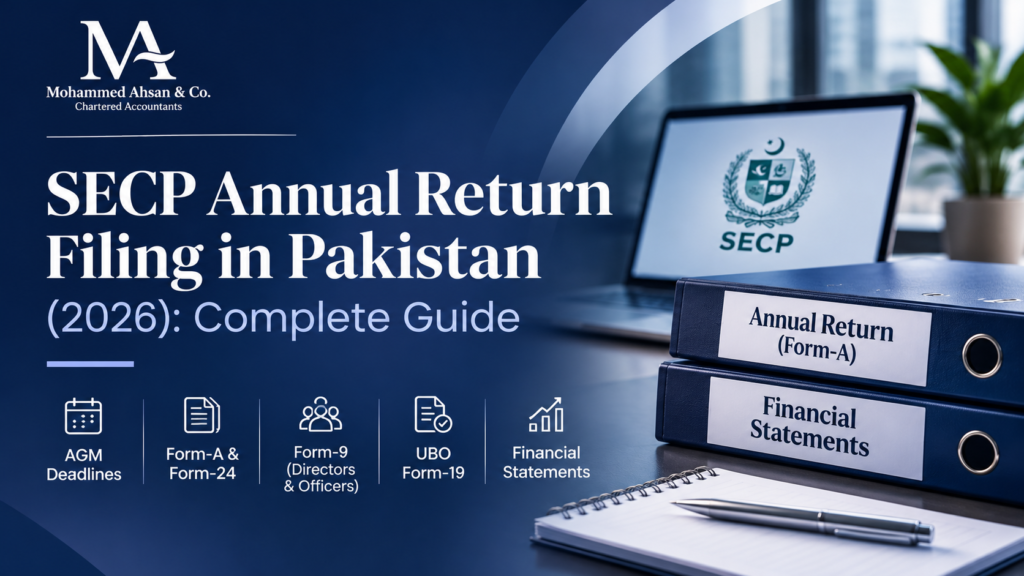
For most Pakistani companies with a 30 June year-end, November and December are the busiest months of the SECP compliance calendar. The annual general meeting (AGM) has been held or is due, the audited accounts are signed, and two statutory filings are now running against the clock. Missing them does not just attract a penalty; it leaves the public record of your company out of date.
This guide explains SECP annual return filing in Pakistan under the Companies Act, 2017, together with the related filing of annual financial statements. It covers who must file, the deadlines that follow the AGM, the exemptions that apply to smaller companies, a worked timeline and the mistakes that most often cause defaults.
According to the Securities and Exchange Commission of Pakistan (SECP), every company must file an annual return once a year under section 130 of the Companies Act, 2017. The return is a snapshot of the company’s particulars: its chief executive, directors, chief financial officer, company secretary, legal adviser, auditors, registered office, members and share capital.
The snapshot is taken on the date of the AGM. If no AGM was held or concluded, the return speaks as at the last day of the calendar year. This is why the annual return cannot be prepared properly until the AGM date, the final shareholding position and the board composition are confirmed.
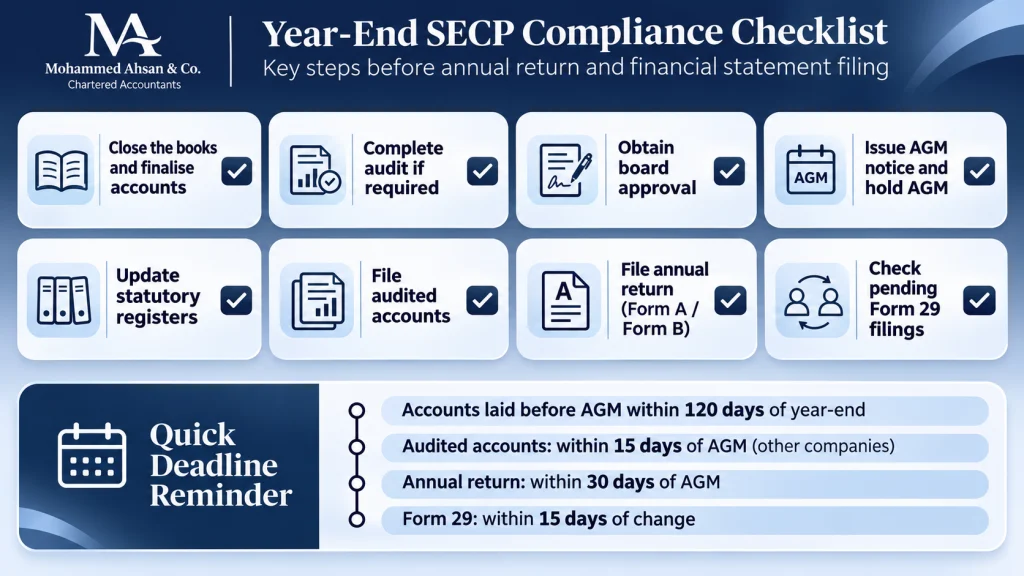
Companies with share capital file Form A, while companies without share capital file Form B. These should not be confused with Form 29, which reports appointments and changes among directors and officers under section 197. SECP’s guidance requires Form 29 within 15 days of an appointment, a change among officers or a change in their particulars, so it should be filed as and when changes occur rather than being left for year-end.
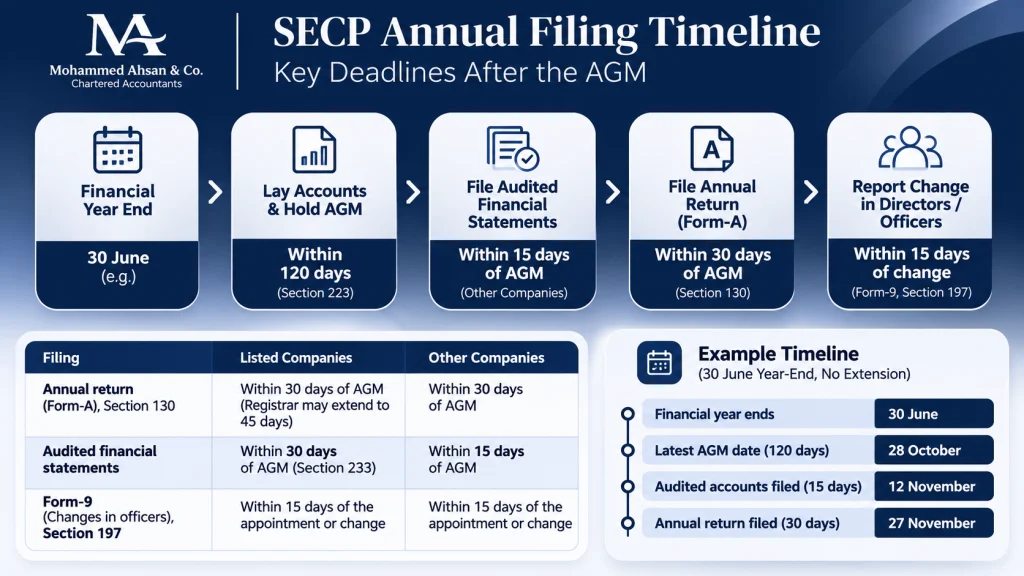
Both statutory filings run from the AGM date, so the AGM itself becomes the starting point of the compliance calendar. The table below summarises the position published by SECP for the main categories of company.
| Filing | Listed Companies | Other Companies |
|---|---|---|
| Annual return (Form A/B), section 130 | Within 30 days of the AGM; the registrar may extend to 45 days | Within 30 days of the AGM |
| Audited financial statements | Within 30 days of the AGM (section 233) | Within 15 days of the AGM |
| Form 29 (changes in officers), section 197 | Within 15 days of the appointment or change | Within 15 days of the appointment or change |
Single member companies are treated separately in SECP’s guidance, and the published page does not state their annual return deadline in plain terms. An SMC should therefore confirm its exact timing against the Companies Act, 2017 and the applicable regulations before relying on the 30-day rule.
The annual return is only half of the year-end obligation. SECP’s guidance on annual financial statements explains that the board must approve the statements under section 183 and lay them before the AGM within 120 days of the close of the financial year, as required by section 223. A copy must also be kept at the registered office for members’ inspection for at least 21 days before the AGM.
Listed companies, foreign companies and most other companies must file audited financial statements. Certain smaller private companies and single member companies, which are not subsidiaries of a public company, may file unaudited statements under section 234, within 30 days of the AGM. SECP’s published page gives two different paid-up capital figures for this category, so the applicable threshold should be confirmed against the Act and current notifications before a company decides not to appoint an auditor.
SECP’s guidance states that the Commission, for listed companies, and the registrar, for other companies, may extend the period for laying the financial statements by up to 30 days. The company must apply and give special reasons. An extension moves the AGM, and with it the filing deadlines, but it is not automatic and should be obtained before the original 120 days expire.
SECP provides a limited relief where nothing has changed since the previous annual return. Single member companies, and private companies with paid-up capital of not more than Rs 3 million, need not file Form A or B in that situation. Other companies also need not file the full form, but they must inform the registrar that there is no change, using the specified return.
This relief is easy to misread. It applies only where there has genuinely been no change in members, directors, officers, share capital or other particulars. If a director has resigned, a share transfer has taken place or the registered office has moved, the full annual return is needed.
Consider a hypothetical private limited company with a 30 June year-end. It is not listed, has an audit requirement and has not applied for an extension. The 120-day period for laying the accounts ends on 28 October, so assume the company holds its AGM on that last permitted day.
| Event | Rule Applied | Resulting Date |
|---|---|---|
| Financial year ends | Year-end | 30 June |
| Latest AGM date | 120 days from year-end | 28 October |
| Audited accounts filed | 15 days from AGM | 12 November |
| Annual return filed | 30 days from AGM | 27 November |
If the registrar had approved the maximum 30-day extension and the AGM were held on 27 November, the same rules would move the filings into December. That is why the compliance window for June year-end companies often stretches to the end of the calendar year. The dates above are illustrative; each company should calculate its own from its actual AGM date.
SECP’s guidance states that a default in filing financial statements under section 233 is penalised at level 2 on the standard scale for listed companies and level 1 for other companies. The company and its officers in default may be exposed, and the amounts depend on the scale and the circumstances of the case.
Enforcement is not theoretical. In January 2026, Profit by Pakistan Today reported that SECP had issued notices to power-sector entities for failures that included non-filing of annual returns under section 130 and annual accounts under section 233. Beyond monetary penalties, repeated defaults can complicate bank due diligence, tenders and investor reviews, because the public record shows the company as non-compliant.
In Karachi, the filing load is often driven by trading companies, manufacturers and professional-service firms with several shareholders and frequent board changes. In Sialkot, many owner-managed exporters and manufacturers operate as private limited companies or single member companies, where the main risk is that statutory records are not updated as the business grows.
Our corporate and SECP services cover AGM preparation, registers, Form A and Form 29 filings and the filing of audited accounts. Where a company also needs the statutory audit, our audit team can align the audit timetable with the AGM and filing calendar from the start, so that the accounts are ready in time.
For most companies it is 30 days from the date of the AGM. For listed companies, the registrar may extend this to 45 days. If no AGM is held or concluded, the return speaks as at the last day of the calendar year.
No. The annual return under section 130 reports the company’s particulars, while the financial statements are filed under section 233 or section 234. They have separate forms and separate deadlines, although both are counted from the AGM.
Form A is the annual return of a company with share capital and Form B is for a company without share capital. Form 29 is filed within 15 days whenever there is an appointment or change among directors or officers.
Not always. Single member companies and private companies with paid-up capital of not more than Rs 3 million need not file Form A or B if there has been no change since the last return. Other companies must still tell the registrar that nothing has changed, using the specified return.
Only with an extension. According to SECP, the registrar may extend the period for laying accounts by up to 30 days for companies other than listed ones, on an application showing special reasons. Without approval, delay is a default.
Yes. The filing obligation attaches to the company, not to its profitability or activity. The no-change relief may reduce the paperwork for eligible companies, but it does not remove the duty to inform the registrar.
SECP year-end compliance is manageable when it is built around the AGM date. Approve the accounts early, hold the meeting within the permitted period, confirm the registers, and then file the audited accounts and the annual return within their separate deadlines. Companies that start in September rather than November usually avoid the last-minute errors that lead to default.
If your company has an AGM approaching or filings outstanding, our team can review your position and prepare the required returns. Contact Mohammed Ahsan & Co., call or WhatsApp +92 346 8900089, or email ahsan@mahsanco.com.
A direct conversation, not a sales pitch.