Knowing how to file sales tax return in Pakistan correctly is a monthly responsibility for every sales tax registered business. For federal sales tax on goods, the return is prepared and submitted through the Federal Board of Revenue (FBR) IRIS portal, where sales invoices, purchase invoices, payments and tax calculations come together in one declaration. A late or inaccurate return can lead to penalties, blocked input tax and a weaker compliance record.
This guide explains who must file, what to prepare, the exact IRIS steps, the annexures, the due dates, nil returns, corrections and the penalties that apply after the Finance Act 2026. It is written for business owners, finance managers and accountants in Pakistan, including those in Karachi and Sialkot. IRIS menu labels can change as the portal is updated, so treat them as a guide and check the FBR’s current instructions before you rely on any screen name.
A sales tax return is the periodic declaration in which a registered person reports output tax charged on sales, input tax paid on purchases and the net amount payable or carried forward. Under the Sales Tax Act, 1990, most registered persons file monthly. The FBR’s page on categories of return also refers to quarterly and annual returns for certain categories, so the first step is always to confirm which category applies to your business.
The return is more than a payment form. It is the document the FBR uses to match your sales against your customers’ purchase claims, and your purchases against your suppliers’ declarations. That matching is why accuracy matters at every step.
Every person registered under the Sales Tax Act, 1990 must furnish a return for each applicable tax period. This includes manufacturers, importers, wholesalers, distributors, retailers and exporters who hold a Sales Tax Registration Number (STRN). It applies whether or not any tax is payable in the month.
The IRIS return covers federal sales tax and federal excise under federal law. Sales tax on most services is administered by provincial authorities, such as the Sindh Revenue Board or the Punjab Revenue Authority, under their own laws and portals. A business that supplies both goods and services may therefore have obligations on more than one system.
Most problems when you file sales tax return in Pakistan start before anyone logs in. Gather the following for the tax period, and reconcile them to your ledger first:
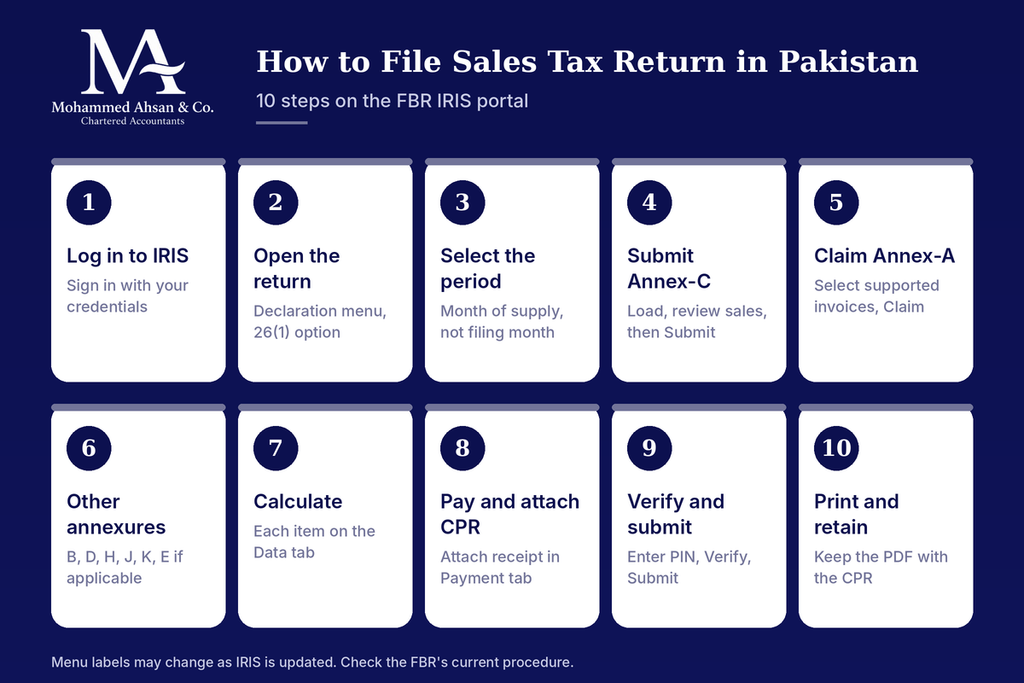
The steps below follow the FBR’s official IRIS procedure for the sales tax and federal excise return. The order of screens may differ slightly for your business type.
Not every annexure applies to every taxpayer who needs to file sales tax return in Pakistan. The table below summarises the main ones named in the FBR’s procedure.
| Annexure | What it covers | Action in IRIS |
|---|---|---|
| Annex-A | Domestic purchases and input tax | Load invoices, filter, select and Claim |
| Annex-B | Imports | Load goods declarations and Claim |
| Annex-C | Domestic sales and sales tax withheld | Review invoices and Submit |
| Annex-D | Exports | Load goods declarations for the period |
| Annex-E | Federal excise | Enter details and Calculate |
| Annex-F and Annex-G | Balance credit and arrears | Calculate on the Data tab |
| Annex-H | Stock statement | Add stock and complete mandatory fields |
| Annex-J and Annex-K | Production data and steel production | Complete where your business is required to |
| Annex-P | Distribution | Calculate on the Data tab |
Business Recorder also reported in 2025 that the FBR added an Annex-C1 to the return, requiring details of payments received against domestic sales invoices. If you invoice on credit, confirm with your adviser how this affects your return.
These clauses connect your return to the compliance of the people you trade with. According to the FBR’s procedure, tax owed by a buyer or supplier who did not file for that period appears in the other party’s return under Clause 7a, and that party cannot file until the displayed tax is paid. Once it is paid, the amount appears under Clause 7c. If the non-compliant party later pays, the amount is credited to that party, deducted from Clause 7c and shown under Clause 7b.
In practice, a return that will not submit is often blocked by a Clause 7a amount. Identify the counterparty and the period before assuming that the portal is at fault.
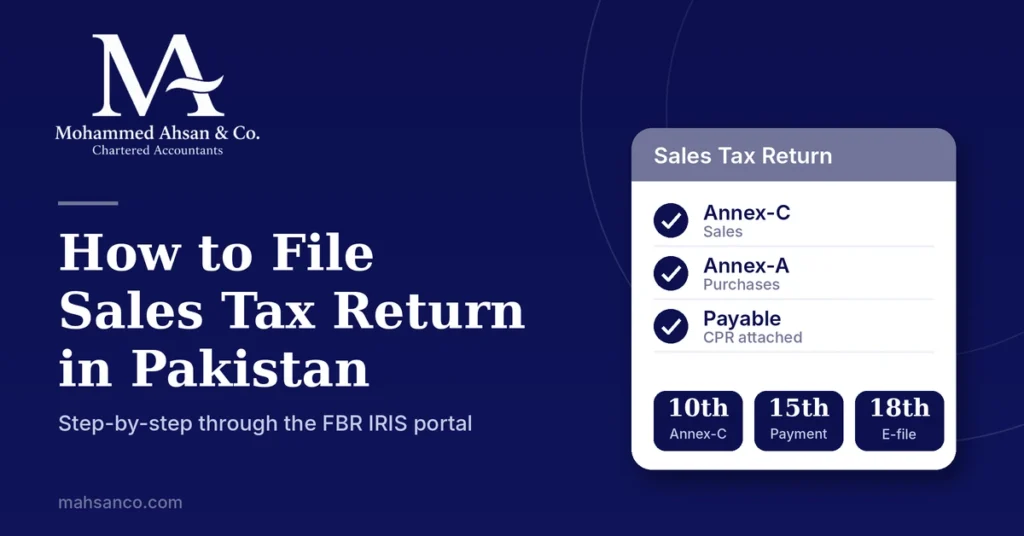
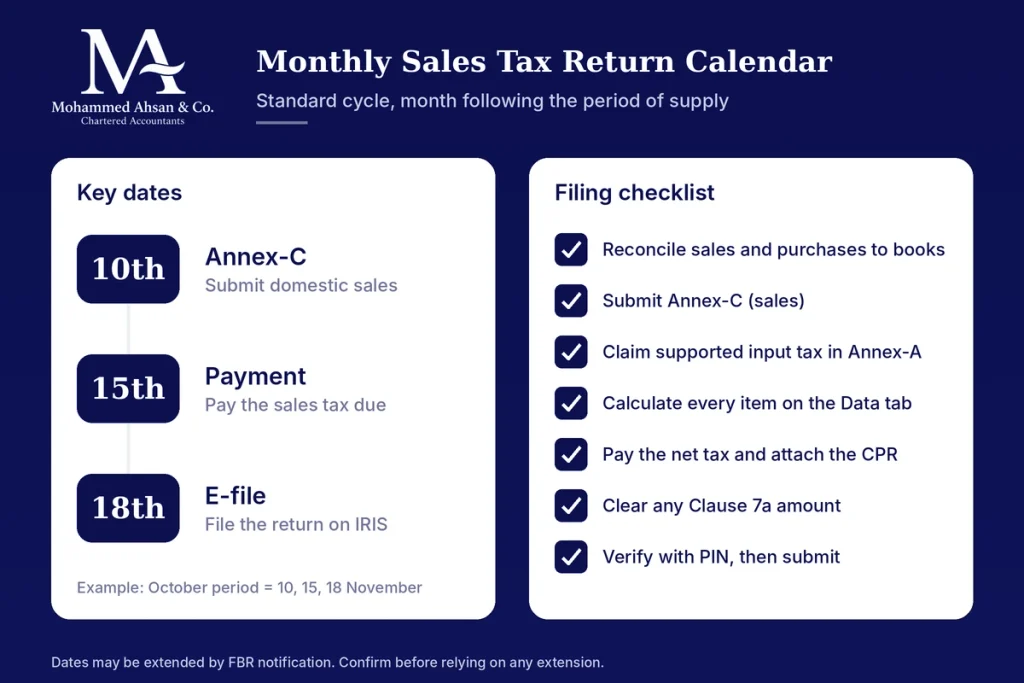
To file sales tax return in Pakistan on time, start with the FBR’s due-dates page, which states the standard procedure: Annexure C on the 10th, payment on the 15th and the e-filed return by the 18th of the month following the period in which the supplies were made. Section 2(9) of the Sales Tax Act, 1990 (as amended up to 30 June 2026) separately defines the return due date as the 15th day after the tax period unless the Board notifies another date.
| Step | Standard date | Example: October 2026 tax period |
|---|---|---|
| Submit Annex-C (sales) | 10th of the next month | 10 November 2026 |
| Pay the sales tax | 15th of the next month | 15 November 2026 |
| E-file the return | 18th of the next month | 18 November 2026 |
The FBR sometimes extends dates by notification. For example, it extended the July 2025 return deadline to 26 August 2025, but only for taxpayers who had deposited the tax liability by the original due date. Never plan around an extension, and always confirm that the notification covers your tax period and category.
A registered person with no sales and no purchases in a month must still file sales tax return in Pakistan for that period. Open the return for the period, confirm that no invoices are loaded, calculate the Data tab items, verify with your PIN and submit. If IRIS blocks submission, check for a Clause 7a amount, an annexure that has not been submitted and any mandatory fields left blank.
Persistent non-filing can attract compliance action, so a nil return should never be skipped on the assumption that nothing is due.
No. The FBR’s procedure states that a submitted return can no longer be edited. Errors are corrected through the revised sales tax return procedure published on the FBR website, and the consequences depend on the facts, such as whether tax was short paid. Because of this, review the return and the CPR before you click Submit, and keep the Save option for drafts.
Penalties for failing to file sales tax return in Pakistan on time changed after the Finance Act 2026. The figures below are those reported in press coverage of the budget and the Act, and should be confirmed against section 33 of the Act as it stands.
| Default | Before Finance Act 2026 | After Finance Act 2026 (reported) |
|---|---|---|
| Failure to file the return by the due date | Rs 10,000 | Rs 50,000 |
| Daily penalty where the return is filed within 10 days after the due date | Rs 200 per day | Rs 2,000 per day |
Default surcharge under section 34 can also apply on tax that is paid late. An ICMA summary of the Finance Act 2026 further reports that unmatched input tax claims attract a 20% penalty, reversal of the inadmissible credit and default surcharge. Even if you rely on these summaries, read the Act and any FBR circular before you advise a client or pay a penalty.
Consider a hypothetical Karachi trading company. In one month it makes taxable sales of Rs 1,000,000 excluding tax, so output tax at the standard rate of 18% is Rs 180,000. Its supported purchases from compliant suppliers total Rs 600,000 excluding tax, giving admissible input tax of Rs 108,000.
The net liability is Rs 72,000 (Rs 180,000 less Rs 108,000), assuming no opening credit, arrears or withheld tax. The company reconciles Annex-C and Annex-A to its ledger, pays Rs 72,000 by the 15th, attaches the CPR, verifies the return and files by the 18th. This example is simplified and ignores apportionment and other adjustments.
Many registered persons must now issue invoices through a system integrated with the FBR. Under the Sales Tax Rules, the sales annexure of the return for an integrated person is built from the electronic invoices issued through that system. Errors made at the invoicing stage can therefore appear directly in your return.
Reconcile your digital invoice totals to your ledger each month before you file sales tax return in Pakistan, and confirm which of the FBR’s notified timelines applied to your business.
Karachi’s importers, distributors, manufacturers and trading companies often face high invoice volumes and several annexures. Sialkot’s manufacturers and exporters usually combine local and export sales, which makes Annex-A, Annex-D and stock reporting especially sensitive. Our team supports businesses in both cities that need to file sales tax return in Pakistan accurately and on time, including with the following:
If recurring errors point to weak controls, an internal audit review can address the cause rather than the monthly symptoms. You can also read more about Mohammed Ahsan & Co..

To file sales tax return in Pakistan for federal sales tax on goods, use the FBR’s IRIS portal. Sales tax on most services is administered by provincial revenue authorities, which have their own portals and returns.
Under the FBR’s standard procedure, Annex-C is due on the 10th, payment on the 15th and the e-filed return on the 18th of the month after the supplies were made. The FBR may extend dates by notification, so check the current notice.
Yes. A registered person should file a nil return for the period. Open the return, confirm that no invoices are loaded, calculate, verify and submit.
No. The FBR’s procedure states that a submitted return can no longer be edited. Corrections are made through the revised return procedure, so review the return carefully before submission.
Common causes include an amount shown under Clause 7a, an annexure that has not been submitted and mandatory fields that remain blank. Resolve the displayed tax or complete the missing item, then try again.
If you file sales tax return in Pakistan late, a fixed penalty applies, and a daily penalty applies if the return is filed within 10 days of the due date. Reported figures after the Finance Act 2026 are Rs 50,000 and Rs 2,000 per day, and default surcharge may apply on late tax. Confirm the figures against section 33 of the Act.
Yes, a registered person can file directly through IRIS. A review is still worthwhile where input tax claims, exports, stock statements or Clause 7a issues are involved, because a submitted return cannot be edited.
A Computerised Payment Receipt is evidence that the tax was paid. In IRIS, it is attached in the Payment tab so that the payment is linked to the return.
To file sales tax return in Pakistan without avoidable problems, prepare the records first, submit Annex-C and Annex-A accurately, pay by the 15th and e-file by the 18th. Treat Clause 7a, nil returns and reconciliation as part of the monthly routine rather than as exceptions. With higher penalties in force, accurate and timely filing is now a cost-control measure as much as a legal duty.
If you would like help with monthly sales tax returns, reconciliations or a pending notice, you can contact Mohammed Ahsan & Co., call or WhatsApp +92 346 8900089, or email ahsan@mahsanco.com.
A direct conversation, not a sales pitch.