Xero payroll support has become one of the most practical ways for Australian employers and accounting practices to keep pay runs accurate while compliance demands keep growing. Single Touch Payroll reporting, Payday Super and the annual award increases all land on the same back-office team, and each pay run now carries more checks than it did two years ago.
Mohammed Ahsan & Co., Chartered Accountants, provides back-office accounting support to Australian businesses from Karachi, Pakistan. This guide explains what outsourced Xero payroll support involves, which 2026 rules it has to handle, and how to judge whether a provider is right for your business.
This article is general guidance and not advice for any individual employer. Confirm your obligations with the ATO, the Fair Work Ombudsman or your registered Australian adviser before acting.
| Area | Current position |
|---|---|
| Payroll reporting | Employers report salary and wages, PAYG withholding and super to the ATO through Single Touch Payroll (STP). Xero states that its payroll is STP Phase 2 compliant. |
| Super timing | From 1 July 2026, Payday Super applies. Contributions must reach the employee’s fund within 7 business days after payday, unless a longer period applies. |
| Super rate | The super guarantee rate has been 12% since 1 July 2025. |
| STP finalisation | Due by 14 July each year. Closely held payees can have a later date of 30 September where the employer also has arm’s length employees. |
| Minimum wage | $26.44 per hour ($1,004.90 per week) from the first full pay period on or after 1 July 2026. Modern award minimum rates rose by 4.75%. |
| Responsibility | With Xero payroll support, the employer remains responsible for pay, reporting accuracy and approvals. The support team prepares, checks and reconciles. |
Xero payroll support is outsourced back-office help with preparing, checking and reconciling payroll inside the client’s own Xero file. The employer keeps ownership of the file and final approval, while the support team handles the repeatable work that consumes management time.
A typical scope covers the following tasks:
Payroll is repetitive, deadline-driven and unforgiving of small errors. Many small and mid-sized Australian employers do not have a full-time payroll officer, and accounting practices often face the same pressure at the end of the financial year when several clients need attention at once.
An offshore team in Karachi can add capacity without a permanent hire. The time difference is five to six hours depending on daylight saving, so work prepared during the Karachi working day is generally waiting for approval when the Australian business opens the next morning. That overlap suits a weekly or fortnightly pay cycle well.
Cost is only part of the case. The more useful benefit is a documented routine: the same checks, in the same order, every pay run. A chartered accountancy team also reads payroll as an accounting process, so wages, tax withheld and super liabilities are reconciled rather than simply paid.
Employers report payroll information to the ATO each payday through STP-enabled software. Xero says its payroll product is STP Phase 2 compliant and sends the report to the ATO every payday. The software transmits the data, but accuracy still depends on how pay items, tax settings and employee records were set up.
At year end, employers must make a finalisation declaration, which the ATO sets for 14 July each year for most employees. Until then, employees may not see finalised income statements to complete their tax returns. Good Xero payroll support builds the finalisation check into the June calendar rather than leaving it to July.
Under Payday Super, super guarantee contributions must be received by, and allocated to, the employee’s fund within 7 business days after payday, unless a longer period applies. The ATO also states that employers report qualifying earnings and super liability through STP and cannot use the Small Business Superannuation Clearing House for payments on or after 1 July 2026. Full details are in the ATO Payday Super checklist for employers.
The rate itself has not changed: the super guarantee rate is 12% for eligible employees. What changed is timing and reporting, and a late, short or misdirected payment can attract the Super Guarantee Charge.
Here is a hypothetical example. An employer pays a weekly employee on Friday 6 November 2026, with $2,000 of qualifying earnings. The super liability is $240 at 12%. Excluding public holidays, the fund must receive it by Tuesday 17 November 2026, but clearing houses and funds need processing time. The safer practice is to release the super payment on payday itself.
[INSERT IMAGE 2 — PAYDAY SUPER TIMELINE INFOGRAPHIC HERE]
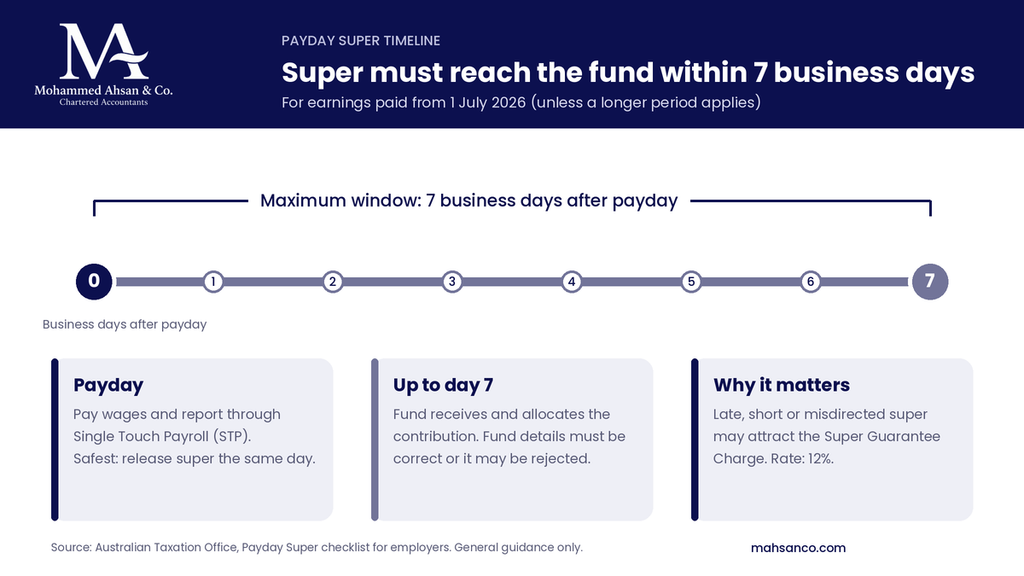
In practice, this makes Xero payroll support a super-timing exercise as much as a wages exercise. Fund details must be verified before payday, because a rejected contribution can quietly push a payment outside the permitted window.
The Fair Work Commission’s 2026 Annual Wage Review lifted the national minimum wage to $26.44 per hour from 1 July 2026, with modern award minimum rates increasing by 4.75%. The Commission’s announcement of decision confirms the national minimum wage figure of $1,004.90 per week.
The increase applies from the first full pay period on or after 1 July 2026. Payroll teams should check every award-covered rate, allowance and loading, and confirm that above-award or annualised salaries still meet the new minimums. Award interpretation stays with the employer or its HR and legal adviser, and state or territory payroll tax should be confirmed with your registered adviser.
The exact routine differs by business, but a well-run cycle usually follows this order:
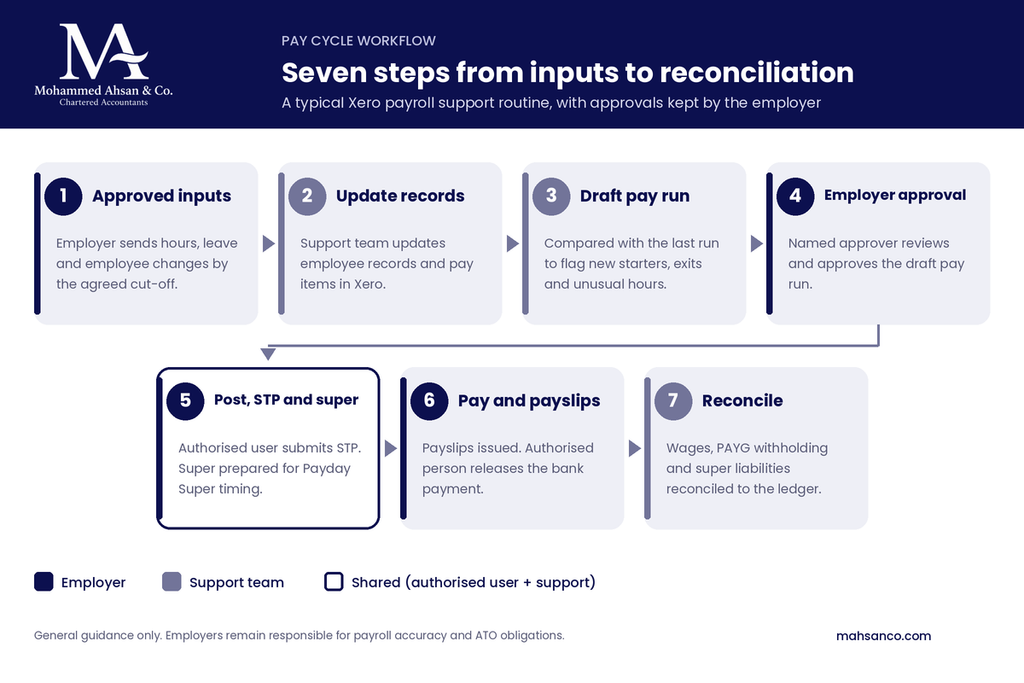
Xero payroll support does not transfer legal responsibility for payroll. A clear split of duties avoids confusion when something goes wrong.
| Task | Employer | Support team |
|---|---|---|
| Pay rates and award decisions | Decides and confirms | Applies the confirmed rates |
| Employee documents | Provides signed forms | Enters and checks the data |
| Pay run approval | Approves the draft | Prepares and reviews the draft |
| Bank payment release | Authorised person releases | Prepares the payment details |
| Reconciliation | Reviews reports | Prepares and explains differences |
| ATO lodgement authority | Employer or its registered agent | Prepares data for review |
Most payroll problems are preventable. These are common errors in Xero payroll files, with the controls that prevent them.
Before appointing any provider, ask for specifics rather than general assurances. A sound provider should be able to explain:
Our Karachi-based team provides Xero payroll support to Australian businesses and accounting practices, including pay run preparation, super batches, payroll reconciliations and year-end readiness. You or your adviser retain approval and ATO lodgement authority, and the scope is agreed in writing. Where a task needs a registered Australian BAS or tax agent, it remains with your Australian adviser.
To learn more about the firm, visit our About page, or contact us to discuss your payroll requirements and pay cycle.
It is outsourced help with preparing, checking and reconciling payroll in your own Xero file. Typical tasks include employee set-up, draft pay runs, super payment preparation, STP review and payroll reconciliations, with your approval at the key points.
Xero lets you invite users with different permission levels, so access can be limited to what the work needs. Your own privacy and data-handling obligations still apply, so confirm requirements with your registered adviser before granting access.
Xero states that its payroll sends Single Touch Payroll reports to the ATO every payday. The report is only as accurate as the underlying set-up, so pay items, tax settings and super details still need to be checked.
For earnings paid from 1 July 2026, contributions must generally be received by the employee’s fund within 7 business days after payday, unless a longer period applies. Paying on payday is the safer approach.
The employer remains legally responsible for paying employees correctly and meeting ATO obligations. Outsourcing improves preparation and review, but it does not transfer that responsibility.
The ATO sets the finalisation declaration date at 14 July each year for most employees, with a later date of 30 September for closely held payees where the employer also has arm’s length employees. See the ATO finalisation guidance for details.
The cost depends on the number of employees, pay frequency, the complexity of awards and allowances, and the agreed scope. A fair quote can only be given after reviewing your current payroll set-up.
Payroll in Australia now involves more reporting, tighter super timing and annual rate changes. Reliable Xero payroll support gives employers a repeatable routine: accurate data in, checked pay runs out, super paid on time and reconciliations completed every cycle.
If you would like a second pair of hands on your payroll back office, message Mohammed Ahsan & Co. on WhatsApp at +92 346 8900089, email ahsan@mahsanco.com, or use the contact page.
A direct conversation, not a sales pitch.