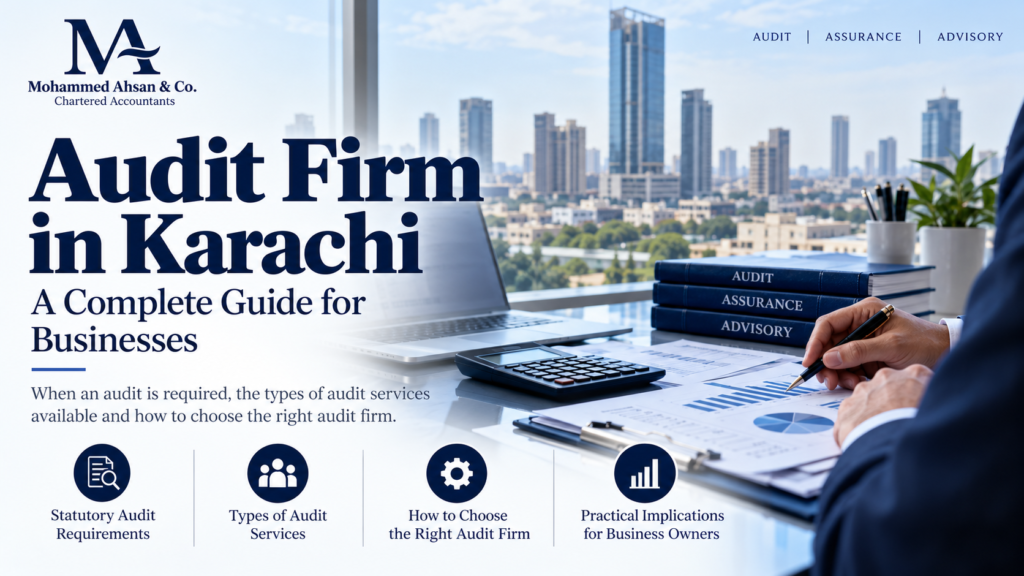
Appointing the right audit firm in Karachi is one of the more consequential decisions a growing business will make. An audit is not simply a compliance formality: it shapes how banks, investors and regulators view a company’s financial statements, and audit findings may help management identify financial reporting and control issues. This guide explains when a statutory audit is required under Pakistani law, the different types of audit and assurance services available, and the factors business owners and finance teams should weigh before appointing an auditor in Karachi.
Karachi remains Pakistan’s principal commercial and financial centre, home to a dense concentration of private limited companies, listed entities and multinational operations. Lenders routinely require audited financial statements before extending or renewing credit facilities, and investors conducting due diligence treat a clean, well-documented audit history as a basic indicator of governance quality.
Beyond financing and investment, an independent financial statement audit provides reasonable, rather than absolute, assurance that the financial statements as a whole are free from material misstatement. It also helps shareholders and directors evaluate the reliability of financial reporting. An audit does not guarantee the accuracy of every transaction or certify that every internal control is effective.

Under section 223 of the Companies Act, 2017, annual financial statements generally require an audit. However, a private company with paid-up capital not exceeding PKR 1 million that is not a subsidiary of a public company is generally exempt, subject to the applicable law and any subsequent SECP notification. Audit requirements, auditor eligibility and filing obligations are separate matters: section 247 sets out auditor qualification rules, including the requirement for a practising chartered accountant or firm of chartered accountants for certain categories, such as private companies with paid-up capital of PKR 3 million or more.
Because applicability may depend on the company’s classification, group relationship and the latest law and SECP notifications, a company should confirm its position rather than rely on size alone. See the SECP guidance on annual financial statements and the applicable Companies Act provisions.
Public companies, listed companies, and entities regulated by sector-specific bodies such as banks, insurers and non-banking finance companies are generally subject to mandatory annual audit regardless of size. Listed companies also face additional governance obligations, including audit committee requirements and compliance with the applicable Code of Corporate Governance, which makes it important to appoint an audit firm with genuine listed-company experience.
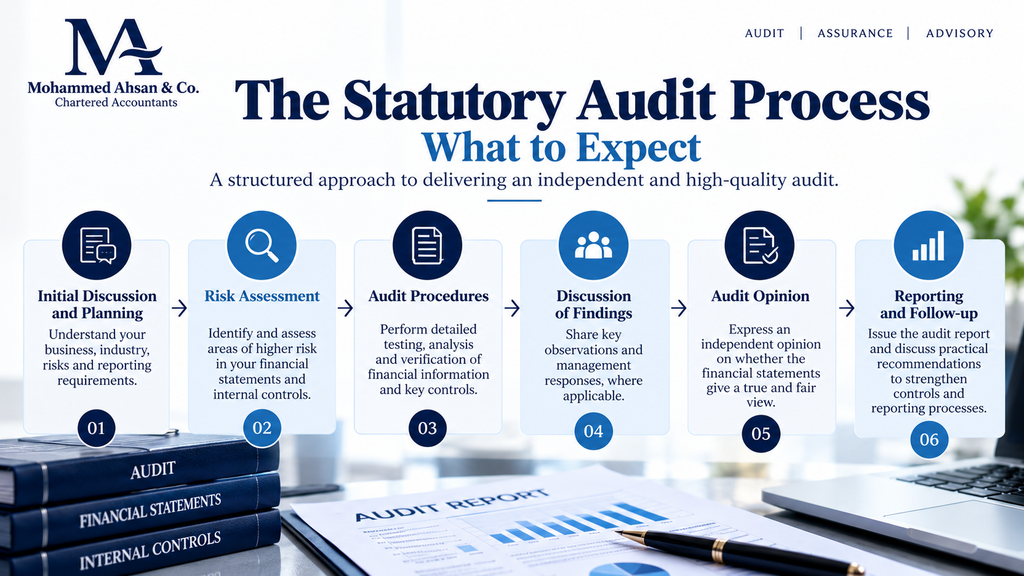
A statutory audit is an independent examination of a company’s financial statements, performed in accordance with International Standards on Auditing (ISA) as adopted by the Institute of Chartered Accountants of Pakistan (ICAP). The objective is for the auditor to form and express an opinion on whether the financial statements give a true and fair view, in all material respects, in accordance with the applicable financial reporting framework.
Internal audit evaluates the design and operating effectiveness of a company’s internal controls, risk management processes and governance arrangements. It is not a legal requirement for most private companies, but it is widely used by well-governed organisations, family businesses transitioning to professional management, and listed companies with formal audit committees that expect ongoing, independent assurance between annual statutory audits.
Businesses may also require work outside the annual statutory audit, such as transaction due diligence, special-purpose assurance or agreed-upon procedures (AUP) relating to loan covenants or fund utilisation. The engagement’s scope and reporting framework must be agreed in advance. Importantly, an AUP engagement reports factual findings and does not provide an assurance opinion; a separate assurance engagement may provide a conclusion when performed under an applicable assurance standard.
| Aspect | Statutory (External) Audit | Internal Audit |
|---|---|---|
| Objective | Opinion on whether the financial statements give a true and fair view | Evaluate internal controls, risk management and governance |
| Required by | Companies Act 2017 / SECP, where applicable | Not legally mandated for most private companies; often used voluntarily or expected by listed-company audit committees |
| Governing standard | International Standards on Auditing (ISA), as adopted by ICAP | Internal audit standards or an internally agreed audit charter |
| Reporting output | Independent auditor’s report attached to the financial statements | Reports to management and, where applicable, the audit committee |
| Typical frequency | Annual | Ongoing or periodic, as agreed with management |
A properly conducted audit does more than satisfy a legal obligation. It strengthens a company’s position when negotiating with banks and investors, gives directors documented assurance over the figures they are accountable for, and often identifies control gaps weak segregation of duties, unreconciled accounts, or incomplete documentation before they develop into larger problems.
For family-owned businesses moving toward more formal governance, and for companies preparing for external financing or a transaction, an independent audit from a firm with genuine Karachi market experience is frequently one of the first steps taken seriously by external stakeholders.
Not automatically. Under section 223 of the Companies Act, 2017, a private company with paid-up capital not exceeding PKR 1 million that is not a subsidiary of a public company is generally exempt from the statutory financial statement audit requirement. Auditor qualification and filing requirements must be assessed separately, and companies should check current SECP notifications and their individual circumstances.
A statutory audit is an independent, externally performed examination resulting in an opinion on the financial statements. Internal audit evaluates internal controls, risk management and governance, and is not mandated by law for most private companies.
ICAP has adopted International Standards on Auditing (ISA) for use in Pakistan, alongside the applicable financial reporting framework — generally IFRS or IFRS for SMEs, depending on the company’s classification under the Companies Act 2017.
Confirm that the firm and its partners are registered with ICAP, the regulatory body for the audit profession in Pakistan. ICAP-registered firms are also subject to a periodic Quality Control Review (QCR).
Timelines vary considerably depending on company size, the state of underlying records, and the complexity of transactions. A realistic engagement timeline is best agreed with the audit firm at the planning stage, once the scope is understood.
Many firms offer both services, but professional and ethical standards place restrictions on certain non-audit services being provided to statutory audit clients, to safeguard independence. A reputable firm will explain which services can be combined for a given client and which cannot.
Typical requirements include financial statements, the general ledger, bank statements and reconciliations, a fixed asset register, payroll records, key contracts, board meeting minutes and prior tax filings. The audit firm will usually provide a detailed document request list at the planning stage.
Whether a statutory audit is already a legal obligation or is being considered as a step toward stronger governance, the choice of audit firm has a direct bearing on how useful that audit is to the business. ICAP registration, QCR standing, direct partner involvement and genuine sector experience are the factors worth checking before any engagement letter is signed.
Mohammed Ahsan & Co. is an ICAP-registered firm of Chartered Accountants based in Karachi, with partners bringing Big Four audit experience and additional team presence in Sialkot. For a conversation about statutory or internal audit requirements for your business, get in touch through our audit and assurance page or contact us directly.
A direct conversation, not a sales pitch.