
If you did not file your Tax Year 2026 return by 31 October 2026, you can still file, but you are unlikely to appear on the Active Taxpayer List (ATL). The Federal Board of Revenue (FBR) updated the list immediately after the extended deadline, and a late return does not restore your status on its own. This guide explains how to become a filer in Pakistan after the deadline, what it now costs and which mistakes to avoid.
The Finance Act 2026 made late filing considerably more expensive, and a surcharge-free route for individuals was notified only on 10 November 2026. This article reflects the position reported as at 22 November 2026. Please confirm current FBR notifications before you act, because IRIS functionality and ATL procedures are still changing.
The short answer is that you can still become a filer in Pakistan after the deadline, because late returns are still accepted, but late filers must now pay to rejoin the ATL. Under section 182A of the Income Tax Ordinance, 2001, a person who does not file by the due date, or by an extended date, is not included in the ATL for that year unless the return is filed and the prescribed surcharge is paid.
The deadline moved twice. The FBR first extended it from 30 September to 15 October 2026 and then, as Dawn reported, to 31 October 2026. Press reports indicate that no further extension followed and that the ATL was updated straight after the deadline, dropping taxpayers who had neither filed a return nor applied for an extension.
| Date | Event |
|---|---|
| 30 September 2026 | Original statutory due date for Tax Year 2026 returns |
| 15 October 2026 | First extension under section 214A |
| 31 October 2026 | Second extension, reported as the final one |
| Immediately after 31 October 2026 | ATL updated; taxpayers who had not filed or applied for an extension reported as removed |
| 10 November 2026 | SRO 2097(I)/2026 notifies Form ATL-U for individuals |
In practice, banks, property registrars and other withholding agents treat inactive taxpayers as non-filers until their names are restored. That is why the ATL matters in everyday transactions and not only on paper.
The process to become a filer in Pakistan applies to individuals, AOPs and companies, with the differences noted where they arise.
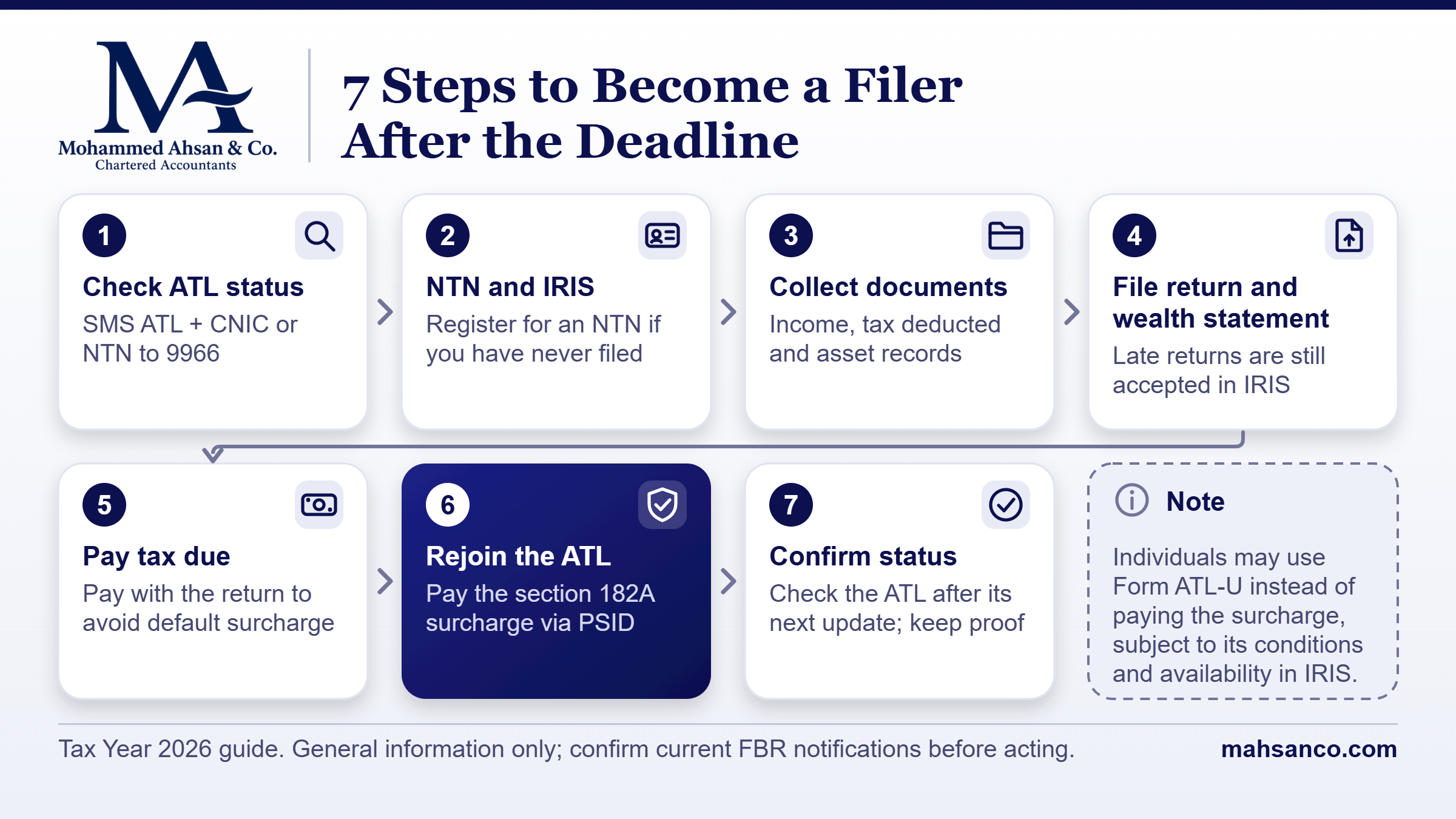
A person who wants to become a filer in Pakistan for the first time must register for an NTN before anything else, then file the Tax Year 2026 return late. A person in that position generally falls within the late-filer rules for this year, so the surcharge or, for individuals, the Form ATL-U route is likely to apply. It is sensible to confirm your category with an adviser before paying anything, because the right amount depends on whether you are filing as an individual, an AOP or a company.
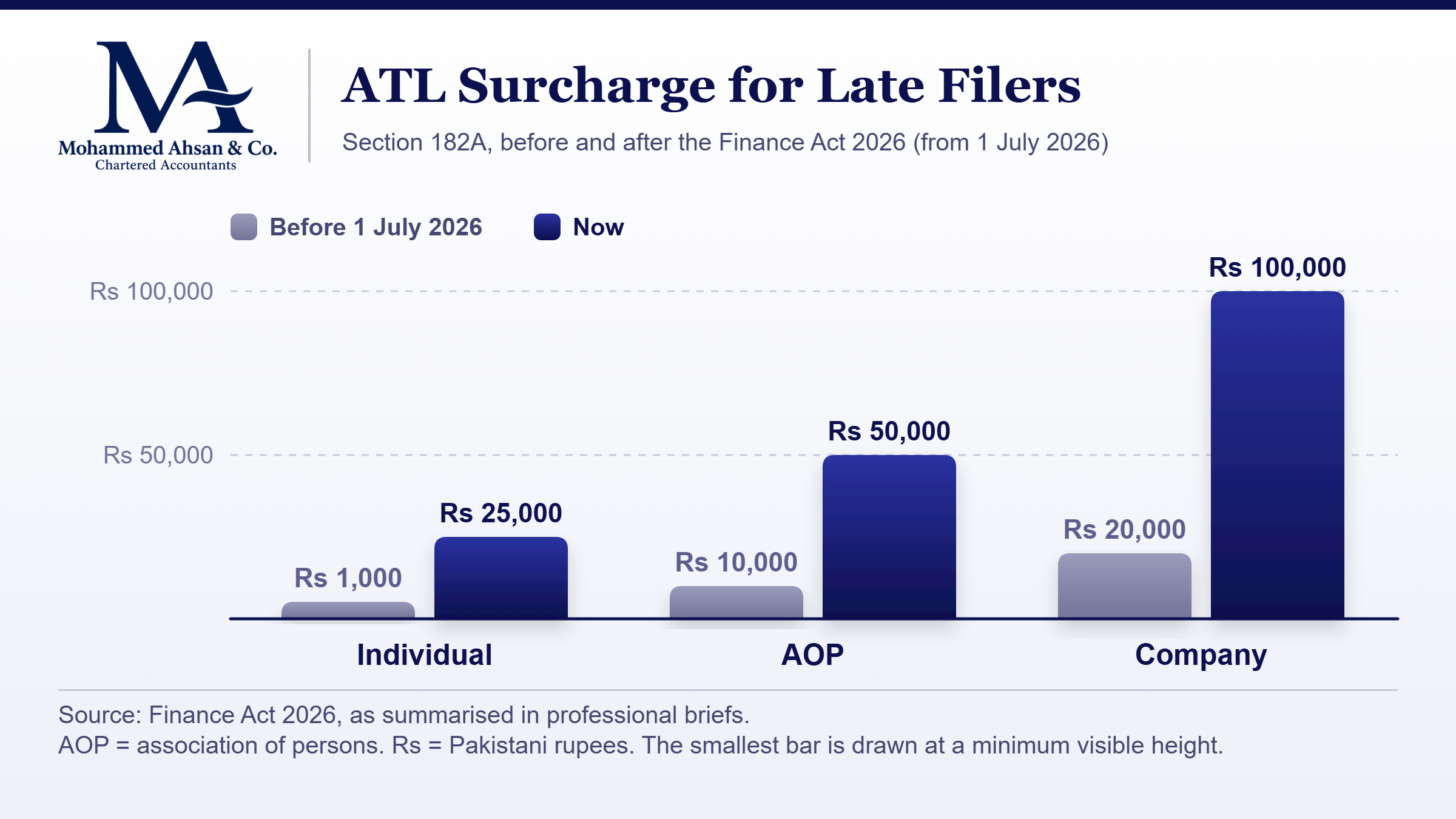
The surcharge is the main cost of rejoining the list for anyone who wants to become a filer in Pakistan after missing the deadline. It is a condition for inclusion in the ATL. It is not a tax and it is not the same as the late filing penalty. The Finance Act 2026 raised the amounts with effect from 1 July 2026, as summarised in KPMG’s brief of the Finance Act 2026.
| Taxpayer Category | Surcharge Before 1 July 2026 | Surcharge Now |
|---|---|---|
| Individual | Rs 1,000 | Rs 25,000 |
| Association of persons (AOP) | Rs 10,000 | Rs 50,000 |
| Company | Rs 20,000 | Rs 100,000 |
Payment is made through a PSID generated for the purpose. Late filers who remain outside the ATL are also reported to be unable to receive tax refunds for the period, so the surcharge needs to be weighed against what ATL status protects.
An individual who wants to become a filer in Pakistan without paying the surcharge may use section 182A(3), which allows an individual who files late to join the ATL by giving an undertaking to the Commissioner. The undertaking is made on Form ATL-U through IRIS. The individual commits not to purchase, acquire or otherwise obtain ownership or beneficial interest in any property for six months from the date on the IRIS acknowledgement.
Availability is the practical issue. On 19 November 2026 the Karachi Tax Bar Association asked the FBR to activate the form after members reported that it was still unavailable on IRIS. If you need ATL status urgently, for example for a bank or property transaction, ask your adviser whether to pay the surcharge now or wait for the form to go live.
The ATL surcharge is separate from the penalty for failing to file by the due date, so anyone planning to become a filer in Pakistan late should budget for both. Under section 182, as clarified by the FBR, the penalty is calculated as follows.
| Element | Rule |
|---|---|
| Daily rate | The higher of 0.1% of the tax payable for the year or Rs 1,000, for each day of default |
| Minimum penalty | Rs 10,000 for an individual with at least 75% of income from salary; Rs 50,000 in other cases |
| Maximum penalty | 200% of the tax payable |
| Reduction for earlier filing | 75%, 50% or 25% if the return is filed within one, two or three months of the due date |
A penalty is generally imposed by the Commissioner after a notice, so a late filer should respond to any notice within the stated time. Confirm how the reduction periods are counted for your case, because the extended date of 31 October 2026 may affect the calculation.
The example below shows what it may cost to become a filer in Pakistan three weeks late. Consider a hypothetical salaried individual whose tax payable for Tax Year 2026 is Rs 300,000. The return is filed on 21 November 2026, 21 days after the extended due date, and all tax is paid with the return.
| Item | Working | Amount |
|---|---|---|
| Section 182 daily rate | Higher of 0.1% of Rs 300,000 (Rs 300) or Rs 1,000 | Rs 1,000 per day |
| Penalty exposure | Rs 1,000 x 21 days; above the Rs 10,000 minimum | Rs 21,000 |
| ATL surcharge (section 182A) | Individual rate, or nil if Form ATL-U is used | Rs 25,000 |
| Total before any reduction | Penalty plus surcharge | Rs 46,000 |
The figures are illustrative. They ignore any reduction for early filing and any default surcharge on unpaid tax, and the actual penalty depends on the notice issued and the Commissioner’s computation.
Staying off the ATL is often costlier than paying once to become a filer in Pakistan. The consequences reported for Tax Year 2026 late filers include the following.
| Withholding Item (Tax Year 2027, as reported) | On the ATL | Not on the ATL |
|---|---|---|
| Profit on bank deposits | 20% | 40% |
| Yield on government securities paid to a non-individual | 20% | 40% |
| Sukuk profit where the holder is a company | 25% | 50% |
These rates are taken from press reports of the FBR’s Tax Year 2027 withholding tax card. Check the current card before relying on them. KPMG’s brief also records that the separate higher “late filer” property rates under sections 236C and 236K were removed by the Finance Act 2026, so confirm the rate that applies on your transaction date.
In Karachi, many people who need to become a filer in Pakistan quickly are salaried professionals, traders and company directors whose bank, property and vehicle transactions are affected by non-ATL withholding rates. In Sialkot, owner-managed manufacturers and exporters usually have business accounts, several withholding streams and a wealth statement that must reconcile, so a rushed late return carries a higher risk of error.
Our team can help individuals, AOPs and companies become a filer in Pakistan after the deadline with a complete and reconciled return. Our tax and advisory services typically include:
You can also read more about Mohammed Ahsan & Co. and our team.
Yes. Late returns for Tax Year 2026 are still accepted through IRIS. However, a late return does not by itself place you on the ATL, and a penalty under section 182 and the section 182A surcharge may apply.
Register for an NTN if you do not have one, file the Tax Year 2026 return and wealth statement in IRIS, pay any tax due, then pay the section 182A surcharge through a PSID or, if you are an individual and the form is available, submit Form ATL-U. Finally, confirm your name on the ATL after the next update.
Under the Finance Act 2026 it is Rs 25,000 for an individual, Rs 50,000 for an AOP and Rs 100,000 for a company. Before 1 July 2026 the amounts were Rs 1,000, Rs 10,000 and Rs 20,000.
Form ATL-U is an undertaking under section 182A(3) available to individuals who file the latest tax year’s return late. The individual undertakes not to purchase, acquire or obtain ownership or beneficial interest in any property for six months from the IRIS acknowledgement date, and is then included in the ATL without the surcharge. AOPs and companies cannot use it.
It is the higher of 0.1% of the tax payable or Rs 1,000 for each day of default. The minimum is Rs 10,000 for individuals with at least 75% salary income and Rs 50,000 otherwise, the maximum is 200% of the tax payable, and reductions of 75%, 50% or 25% are available for filing within one, two or three months.
The FBR refreshes the ATL periodically, and the date of the latest update is shown on its download page. Your name may therefore not appear immediately after you file and pay, so check again after the next update.
It depends on the Commissioner’s decision, and reports differ on how the ATL treated applicants this year. Check your status, keep the application acknowledgement and ask your adviser to follow up on the decision.
It depends on your transactions. If you regularly deal with banks, property or vehicles, higher non-ATL withholding rates and the loss of refunds can quickly exceed the surcharge. If you have few transactions, weigh the cost against the filing obligation, which remains in any case. An adviser can model both for your situation.
Missing the 31 October 2026 deadline is costly but fixable. To become a filer in Pakistan after the deadline, file a complete and accurate return, pay the tax due, settle the right surcharge or use the Form ATL-U route if it suits you, and confirm your status on the ATL. The sooner you act, the lower the section 182 exposure and the shorter the period in which non-filer withholding rates apply.
If you need to become a filer in Pakistan after the deadline, our team can review your position and prepare the return. Contact Mohammed Ahsan & Co., call or WhatsApp +92 346 8900089, or email ahsan@mahsanco.com.
A direct conversation, not a sales pitch.