Choosing the best audit firm is one of the most consequential decisions a board makes each year. The right auditor protects the credibility of your financial statements with banks, investors, buyers and regulators. The wrong one can leave you with avoidable queries, a late audit report or, in some cases, an appointment that does not meet the law.
For a Karachi business, the best audit firm is not automatically the largest, the cheapest or the best known. It is the firm that is legally eligible to audit your entity, runs a tested system of quality management, stays independent, understands your industry and communicates clearly. This guide sets out seven practical checks, based on the Companies Act, 2017 and ICAP’s quality-assurance framework, so you can compare firms on evidence rather than reputation.
A note on the word “best”: this article does not rank any firm. A Quality Control Review (QCR) rating and Audit Oversight Board (AOB) registration are indicators of regulatory standing, not league tables. The regulatory position below was reviewed in November 2026, and you should confirm current requirements before you appoint.
The best audit firm for your company is the one that can lawfully, independently and competently audit your specific entity, and then explain its findings in a way your board can act on. Brand, office size and price come after those four tests.
An external audit gives shareholders and other users reasonable assurance that the financial statements are free from material misstatement. That assurance is only as reliable as the auditor’s competence and independence. This is why Pakistan’s regulators look at an audit firm’s quality-control system as well as at the individual engagement partner.
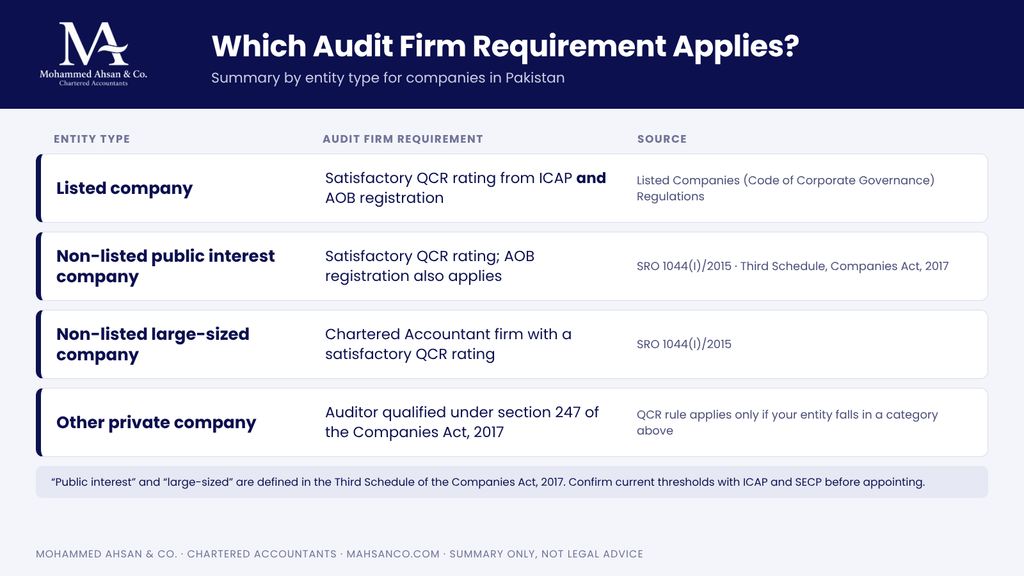
Before you compare firms, confirm what the law requires for your type of entity. Section 246 of the Companies Act, 2017 covers appointment, removal and fee, while section 247 sets out who is qualified, and who is disqualified, from acting as auditor. Read both alongside the rules that apply to your sector, including the requirements summarised on the ICAP Quality Assurance pages.
| Entity type | Audit firm requirement | Where it comes from |
|---|---|---|
| Listed company | Satisfactory QCR rating from ICAP and AOB registration | Listed Companies (Code of Corporate Governance) Regulations, as summarised by ICAP |
| Non-listed public interest company | Chartered Accountant firm with a satisfactory QCR rating; AOB registration also applies where the entity is a public interest company | SRO 1044(I)/2015; Third Schedule, Companies Act, 2017; SECP notifications |
| Non-listed large-sized company | Chartered Accountant firm with a satisfactory QCR rating | SRO 1044(I)/2015 |
| SECP-regulated financial entity (for example, an insurer) | Auditor from SECP’s approved list or with a satisfactory QCR rating, depending on category and asset size | SECP approved-auditor notifications, revised from time to time |
| Other private company | Auditor qualified under section 247; the QCR requirements above apply only if your entity falls in a listed category | Companies Act, 2017 |
“Public interest company” and “large-sized company” are defined in the Third Schedule of the Companies Act, 2017, and the thresholds can change. Check the current Third Schedule, or ask your adviser to confirm which category your company falls into, before you shortlist anyone.
ICAP’s Quality Control Review programme examines an audit firm’s system of quality control and reviews selected audit engagements, which results in a rating. Where your entity must use a QCR-rated firm, the rating must be satisfactory, and you are expected to help your auditor’s working-paper files reach ICAP’s Quality Assurance Department for review.
A satisfactory rating is a regulatory pass, not a ranking, so it cannot by itself identify the best audit firm for you. It shows that the firm’s system met ICAP’s review standard when it was reviewed. It does not tell you whether the firm suits your industry, timetable or budget. ICAP also runs an Audit Practice Review and Support programme for firms outside QCR, so a firm without a rating is not necessarily unreviewed, but it may not be eligible where QCR is mandatory.
The AOB was established under the SECP Act, 1997 to oversee auditors of public interest companies. A firm can register with it only on the recommendation of ICAP’s Quality Assurance Board. If your company is listed or is otherwise a public interest company, ask each prospective auditor for its current AOB registration status in writing. Oversight arrangements have been under legislative review, so verify the position with the Securities and Exchange Commission of Pakistan (SECP) when you appoint.
Use these seven checks as a scorecard when you request proposals and decide which is the best audit firm for your circumstances. They work equally well for a first appointment and for a change of auditor.
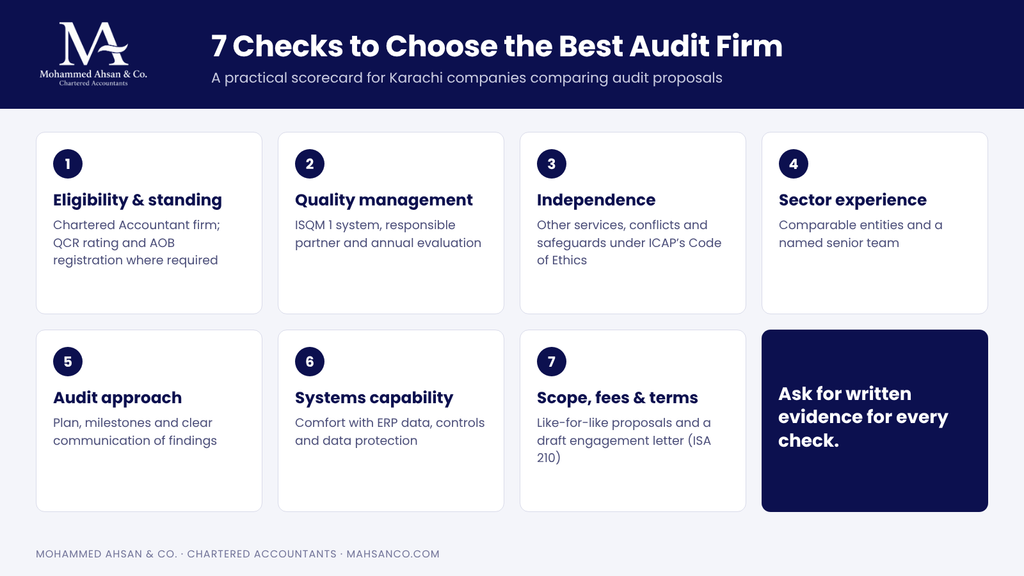
Start with the non-negotiable points. Ask each firm to confirm in writing that it is a firm of Chartered Accountants, that none of the section 247 disqualifications applies to the engagement team, and, where relevant, that it holds a current satisfactory QCR rating and AOB registration. Request the date of the latest rating instead of accepting a general assurance.
ICAP adopted ISQM 1, ISQM 2 and revised ISA 220 in November 2022. They became effective on 15 December 2023 for firms auditing public interest companies and on 15 December 2024 for other firms, as recorded on ICAP’s ISA adoption page. ASEB Circular 07 of 2025 later set 1 July 2026 for firms auditing only small and medium-sized companies, so every audit firm should now be working under the standard.
Ask how the firm identifies and responds to quality risks, who carries ultimate responsibility for its system of quality management, and whether the annual evaluation has been completed. A specific, confident answer is a good sign.
Independence is the foundation of audit credibility. Ask whether the firm provides, or has provided, other services to your company, such as bookkeeping, tax advice or system implementation. Some combinations create self-review or familiarity threats that must be evaluated under ICAP’s Code of Ethics and handled through safeguards or by declining the work. A firm that raises these points before you ask is showing the right instincts.
Industry knowledge shortens the audit and sharpens the findings. A manufacturer in Korangi faces different inventory, costing and export-documentation risks from a services company in DHA. Ask which senior people will actually lead your engagement, how much partner time is planned, and whether the team has audited comparable entities under IFRS or IFRS for SMEs. The best audit firm for your sector will answer with named examples of the work, without disclosing client confidences.
A good audit should not produce surprises at year-end. Ask for the proposed audit plan, key milestones, the timing of any interim visit and how significant findings will be communicated. Under the International Standards on Auditing, auditors communicate significant matters to those charged with governance (ISA 260) and report significant deficiencies in internal control (ISA 265). The best audit firm for you will turn those requirements into a practical management letter with prioritised recommendations, not a generic checklist.
Most Karachi companies now keep their records in ERP or accounting software. Ask how the firm tests data from systems such as Odoo, QuickBooks or Xero, how it protects your files, and whether its team is comfortable reviewing system-generated reports and controls. Technology should reduce audit effort and improve evidence, not simply add a tool name to the proposal.
Request written proposals on the same scope: statutory audit only, or audit plus any additional reports required by lenders or regulators. Compare the fee basis, expected hours, reporting deadlines and what happens if information arrives late. Under ISA 210, the terms of the engagement must be set out in an engagement letter, so ask to see a draft before you appoint. An unusually low fee is a reason to ask how the work will be resourced, not a bargain by default.
Once you have two or three candidates, put the same questions to each and ask for evidence, not just answers. The table below turns the seven checks into a practical request list.
| Area | Question to ask | Evidence to request |
|---|---|---|
| Regulatory standing | Do you hold a current satisfactory QCR rating and AOB registration where they apply? | Written confirmation with dates |
| Quality management | Who is responsible for your ISQM 1 system, and when was it last evaluated? | Summary of the evaluation process |
| Independence | Do you provide any other service to our company? | Independence confirmation and safeguards |
| Team | Who will lead the engagement and review the file? | Named partner and manager with relevant experience |
| Communication | When will we hear about significant findings? | Audit plan and reporting timetable |
| Terms | What is included in the fee, and what is excluded? | Draft engagement letter |
Karachi’s business base is varied: exporters and manufacturers in SITE, Korangi and Landhi, trading companies, and service businesses in DHA and the city’s commercial districts. Each has different audit priorities. Manufacturers and exporters need strong inventory, costing and export-documentation work, while service businesses need careful revenue and contract testing.
Timing is a local issue too. Where a company closes its books on 30 June, audit capacity can become tight in the months that follow, and a bank or buyer may be waiting for the signed report. Agree the timetable at appointment rather than at year-end.
Hypothetical example: a privately held garment exporter in Korangi, which is not listed and may or may not meet the large-sized company thresholds, is trying to identify the best audit firm from two proposals. Before comparing fees, the finance manager checks the Third Schedule, confirms whether QCR applies, requests each firm’s ISQM 1 summary and independence confirmation, and asks who the engagement partner will be. Only then does the fee become a deciding factor. The process takes about a week and avoids an appointment problem later in the year.
Mohammed Ahsan & Co. is an ICAP-registered firm of Chartered Accountants in Karachi. Our practice includes external and internal audit, IFRS-based financial reporting, SECP and corporate compliance and ISQM quality-management support for audit practices.
If you are comparing the best audit firm options for your company, we can help you work out which regulatory requirements apply to your entity and what a sensible audit scope looks like before you decide. Rating and registration status should always be confirmed against current ICAP and SECP records, and we encourage every client to ask any firm, including ours, for that evidence.
There is no single best audit firm for every company. The right firm is eligible for your entity, holds any rating or registration the law requires, is independent of your business and has relevant experience. Shortlist firms against the seven checks in this article and compare written proposals.
It depends on your category. Listed companies must appoint a firm with a satisfactory QCR rating that is also registered with the AOB. Non-listed public interest companies and large-sized companies must appoint a Chartered Accountant firm with a satisfactory QCR rating under SRO 1044(I)/2015. Other private companies are not covered by those requirements, but their auditor must still be qualified under section 247 of the Companies Act, 2017.
No. Pakistani law tests eligibility, qualification and, where applicable, QCR rating and AOB registration, not a firm’s size or international affiliation. A large firm may suit a complex group, while a smaller firm with a satisfactory record and relevant experience can be a better fit for others. Evidence matters more than brand.
As early as practicable. Section 246 of the Companies Act, 2017 governs appointment and removal, and the auditor needs time to plan, agree terms under ISA 210 and perform interim work. Appointing close to year-end compresses all three.
Sometimes, but it can threaten independence. The firm must evaluate the threat under ICAP’s Code of Ethics and apply safeguards, or decline the service. Disclose any existing services when you request audit proposals so that the firm can assess this properly.
ISQM 1 is the quality-management standard that audit firms follow. It requires a risk-based system covering areas such as governance, ethics, client acceptance, resources and monitoring. For a client, it means the firm should be able to show how it manages audit quality rather than simply asserting it.
Ask the firm for written confirmation of its current QCR rating and, where relevant, AOB registration, including dates. You can also confirm directly with ICAP’s Quality Assurance Department and review the SECP notifications that apply to your sector.
The best audit firm for a Karachi company is the one that passes the legal tests first and the practical tests second. Confirm eligibility and any QCR or AOB requirement, ask how the firm manages quality under ISQM 1, test independence, and compare scope and fees on the same basis. Done properly, the selection process takes days and protects the credibility of your financial statements for years.
If you would like to discuss your audit requirements, contact our Karachi team, email ahsan@mahsanco.com or message us on WhatsApp at +92 346 8900089.
A direct conversation, not a sales pitch.