Company registration in Karachi gives entrepreneurs a formal legal structure for ownership, contracting, banking and growth. For a business seeking limited liability, the usual route is incorporation with the Securities and Exchange Commission of Pakistan (SECP) under the Companies Act, 2017. The procedure is primarily online through SECP’s eZfile system, subject to the Companies Regulations, 2024 and other applicable requirements. This practical guide explains the structures available, documents to prepare, incorporation steps, fees, and what business owners must consider after registration.
Although the incorporation rules are national, Karachi businesses should also plan for Sindh-specific tax, labour and operational requirements. The right structure and compliance plan depend on the business activity, ownership and regulatory status. For local founders, company registration in Karachi also involves planning for Sindh-specific obligations after incorporation.
A company incorporated under the Companies Act, 2017 is a separate legal person. It can generally enter into contracts, hold property and conduct business in its own name. In a company limited by shares, shareholder liability is ordinarily limited to the unpaid amount, if any, on the shares held. However, incorporation does not eliminate personal exposure arising from personal guarantees, misconduct or other legal obligations.
A properly structured company can also help establish clearer ownership, support banking and commercial due diligence, and provide a framework for governance. It is not necessarily the best choice for every small business: an owner should compare ongoing compliance costs, tax treatment and the requirements of prospective customers or investors before incorporating. For growing businesses, company registration in Karachi can formalise ownership and make commercial due diligence more straightforward.
| Item | Summary |
|---|---|
| Primary company law | Companies Act, 2017; Companies Regulations, 2024 |
| Company regulator | Securities and Exchange Commission of Pakistan (SECP) |
| Online filing system | SECP eZfile |
| Company types | Single-member company, private limited company and public limited company |
| Alternative structures | Sole proprietorship, partnership/AOP and LLP (governed by different laws) |
| Name application | Name reservation separately or combined with incorporation |
| Incorporation result | Certificate of Incorporation and Corporate Unique Identification Number (CUIN) |
| After incorporation | Verify NTN, arrange banking, maintain records and assess statutory and provincial filings |
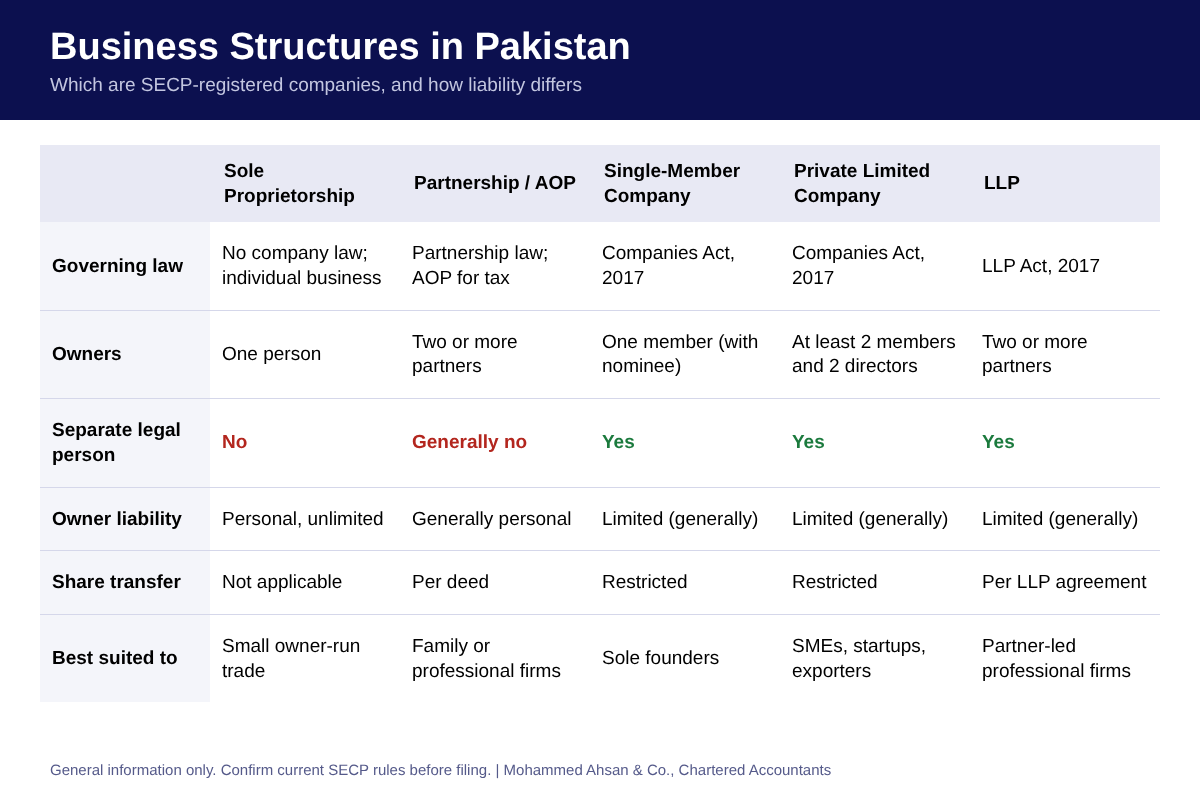
The business structure affects liability, ownership, governance, investor participation and compliance. Importantly, not every business structure below is registered as a company under the Companies Act, 2017. Before starting company registration in Karachi, compare the governance and compliance responsibilities of each structure.
| Structure | Typical use | Key distinction |
|---|---|---|
| Sole proprietorship | Single-owner small business | Owner and business are not separate legal persons; not an SECP-incorporated company |
| Partnership / AOP | Business with two or more partners | Ordinary partnerships generally involve personal liability; registration and tax treatment differ from a company |
| Single-member company (SMC) | One founder seeking corporate limited liability | One member; prescribed nominee arrangements apply |
| Private limited company | SMEs, startups and growing businesses | At least two members and two directors; share transfers are restricted |
| Public limited company | Businesses requiring a wider ownership structure | At least three members and three directors; additional legal requirements apply |
| Limited liability partnership (LLP) | Professional and other partner-led businesses | Separate structure under the Limited Liability Partnership Act, 2017; not incorporated under the Companies Act |
A private limited company is a common choice for businesses that expect to add partners, raise capital privately or work with institutional customers. It generally requires at least two members and two directors. Its articles must reflect the restrictions applicable to a private company, including restrictions on share transfers and public invitations to subscribe for shares. Many SMEs and startups evaluate this structure first when planning company registration in Karachi.
A single-member company allows one person to form a company without adding a second shareholder solely to meet a member-count requirement. SECP’s rules require a nominee arrangement, and an SMC has specific governance and filing concessions. These should be considered alongside its continuing record-keeping and disclosure obligations. A single-member company can be a practical option for sole founders considering company registration in Karachi.
An LLP may be suitable for businesses organised around partners rather than shareholding. It is registered with SECP under the Limited Liability Partnership Act, 2017 framework, not incorporated as a company under the Companies Act. Its documentation and ongoing requirements therefore differ from those of a private limited company.
Before starting an application, prepare the information applicable to your proposed company type. SECP may require additional documents for foreign participation, regulated activities or unusual ownership structures. Preparing verified identity details and ownership information can reduce avoidable delays in company registration in Karachi.
If a correspondence address is used at incorporation because a registered office has not yet been established, the company must notify its registered office to SECP within the statutory period, generally 30 days after incorporation.
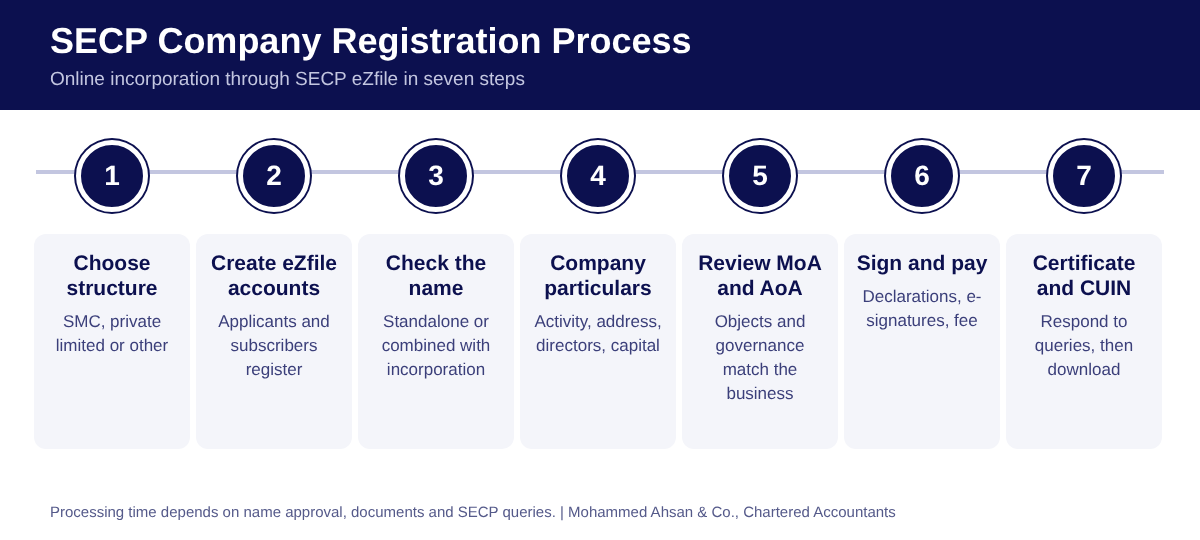
SECP’s current online platform is eZfile. The following is a practical overview rather than a substitute for the portal’s current prompts. You can also consult the official SECP company registration guidance. For company registration in Karachi, the same federal eZfile process applies as in other Pakistani cities.
An approved company name is not a licence to operate a regulated business. Additional authorisation may be required before starting activities such as financial services, insurance or other licensed operations.
Incorporation charges depend on factors including the company type, nominal or authorised capital, filing mode and any additional services selected. Fees and administrative procedures can change. Rather than relying on an outdated fixed amount, use SECP’s official Company Incorporation Fee Calculator and verify the payable amount in eZfile before submission. The total cost of company registration in Karachi depends on the chosen structure, capital and any professional support required.
SECP fees are only part of the formation budget. Consider professional assistance, required attestations or approvals, banking and accounting setup, and continuing corporate and tax compliance. Not every applicant will incur every category of cost.
Processing depends on the type and completeness of the application, name availability, payment verification, regulatory approvals and any objections raised by SECP. Straightforward online applications may be processed promptly, but an outcome within a specific number of days should not be promised.
The core incorporation law and SECP filing system apply nationally. Karachi businesses should nevertheless assess the regulatory requirements arising from where they operate, employ staff, provide services, sell goods or import and export. After company registration in Karachi, applicable Sindh tax and employment registrations depend on the company’s activities.
For matters requiring assistance from the local office, SECP currently lists the Karachi Company Registration Office at Dawood Center, Ground Floor, MT Khan Road, Civil Lines, Karachi. Since office arrangements can change, verify the address and contact details on SECP’s official contact page before visiting. Most routine incorporation applications can be completed online.
Business activities determine which registrations are necessary. The Sindh Revenue Board (SRB) administers sales tax on taxable services in Sindh, while the Federal Board of Revenue (FBR) administers federal taxes, including sales tax on taxable goods and imports. Depending on staffing and operations, SESSI, EOBI, labour, professional tax or other registrations may also require attention. Incorporation alone does not settle all these obligations.
Choose an address at which statutory correspondence can be received and supporting documents can be provided when needed. Banks and tax authorities may independently verify the address. If SECP permits a correspondence address at incorporation, ensure the formal registered-office notification is completed within the prescribed period. Plan the address early, because it affects both company registration in Karachi and later banking and tax onboarding.
The Certificate of Incorporation establishes the company, but it is not the end of its compliance work. The following checklist should be tailored to the entity’s legal status and activities. Completing company registration in Karachi does not replace ongoing accounting, tax and corporate filing duties. Key points include:
In particular, not every company has the same statutory audit or annual filing obligations. The correct position depends on the entity type, capital, reporting period, applicable thresholds and exemptions. See SECP’s guidance on annual financial statements, annual returns and UBO disclosures.
There is no guaranteed standard timeline for every case. Processing depends on name acceptance, completeness of information, payment, additional regulatory approvals and any objections raised through eZfile.
Yes. An individual may form a single-member company (SMC), subject to the applicable nominee and filing requirements. A standard private limited company generally needs at least two members and two directors.
Yes. SECP eZfile supports both a standalone name-reservation process and a combined name-reservation and incorporation process.
Most standard company incorporation filings can be completed online through eZfile. A physical visit may be needed for an exceptional case or specific assistance; verify current CRO contact details before travelling.
In general, participation is possible subject to identity verification, applicable documentation, sector-specific restrictions, security clearances and other legal conditions. Requirements differ based on nationality, residence and proposed business activity.
There is generally no single fixed paid-up capital amount prescribed for every ordinary private company. Subscribers must take the shares required by the incorporation framework, and regulated businesses may have separate capital requirements. Capital selection should reflect the business plan and current SECP rules.
SECP and FBR have an integrated NTN registration facility, but business owners should verify successful NTN issuance and their taxpayer details. Separate sales tax, withholding or provincial compliance may still apply.
No universal answer applies to every company. Audit, financial-statement filing and annual-return obligations depend on the company category, legal thresholds, reporting requirements and available exemptions. Obtain an entity-specific compliance assessment.
Verify NTN and registered-office particulars, arrange banking, maintain statutory and accounting records, review UBO/Form-19 requirements, obtain any licences and set a calendar for applicable tax and SECP filings.
Company registration in Karachi is a manageable process when the legal structure, ownership, proposed name and documents are planned carefully. SECP’s eZfile system simplifies filing, but business owners should also consider tax registrations, the registered-office requirement, beneficial ownership reporting and ongoing compliance. These decisions are easier to address before operations and transactions begin.
For guidance on company registration in Karachi, including documentation, tax registrations or ongoing accounting and corporate compliance, contact Mohammed Ahsan & Co., Chartered Accountants via our Contact page, WhatsApp at +92 346 8900089, or email ahsan@mahsanco.com.
Editorial note: This article provides general information and is not a substitute for advice tailored to a particular company. SECP procedures, forms, thresholds and tax requirements may change; confirm the latest position before filing.
A direct conversation, not a sales pitch.