FBR digital invoicing has changed how sales tax invoices are issued in Pakistan. Instead of preparing an invoice in your own system and reporting totals later in a monthly return, a registered person must now generate each invoice through a system connected to the Federal Board of Revenue (FBR). The system validates the invoice in real time and returns a unique FBR invoice number.
This guide explains the legal basis, who must comply, the rollout timetable, what a digital invoice must contain, how integration works, the 72-hour correction rule and the penalties revised for 2026. It is written for business owners, finance managers and accountants in Pakistan, including those in Karachi and Sialkot.
FBR Digital Invoicing is the Board’s real-time e-invoicing system for sales tax. Each sales tax invoice is transmitted to the FBR’s computerised system at the time it is generated. The FBR’s system returns a unique invoice number, and the invoice must carry that number together with a QR code and the Digital Invoicing logo.
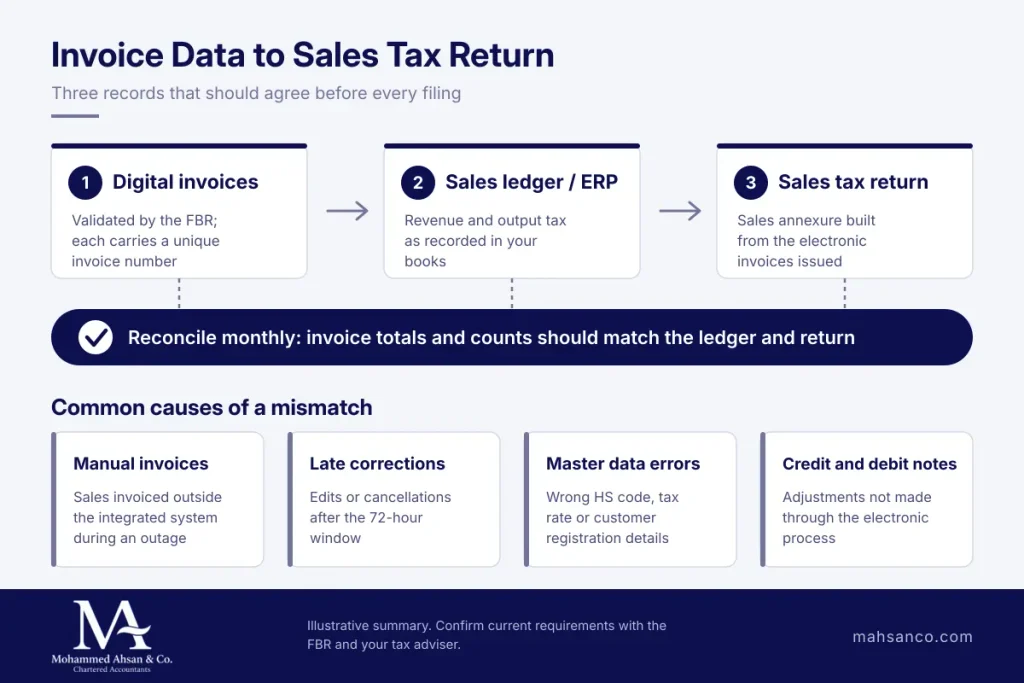
The practical effect is a shift from periodic reporting to transaction-level reporting. Under the Rules, the sales annexure of the sales tax return is auto-filled from the electronic invoices issued by the integrated person, so the invoice record and the return are linked.
Section 23(5) and (6) of the Sales Tax Act, 1990 allow the Board to require any person or class of persons to integrate their electronic invoicing system with its computerised system for real-time reporting of sales. Integration must be carried out through licensed integrators. According to the FBR’s Sales Tax and Federal Excise Circular 02 of 2025-26, these sub-sections were inserted in section 23 after being transposed from section 40C.
The procedure is set out in Chapter XIV of the Sales Tax Rules, 2006, which was substituted by SRO 69(I)/2025. The Finance Act 2026 has since widened section 23(1) on tax invoices and added a proviso to section 9 stating that debit and credit notes will follow the mechanism, including electronic adjustments, prescribed by the Board.
Digital invoicing applies to sales tax registered persons. The requirement began with a two-category schedule under SRO 709(I)/2025, which was replaced by SRO 1413(I)/2025 and then by SRO 1852(I)/2025. The current category schedule, which is based on turnover declared in the last twelve months’ sales tax returns, is summarised below.
| Category | Registration and testing by | E-invoices from |
|---|---|---|
| Public companies, other companies with turnover above Rs 1 billion, and importers | 15 October and 25 October 2025 | 1 November 2025 |
| Individuals and associations of persons with turnover above Rs 100 million | 10 October and 25 October 2025 | 1 November 2025 |
| Other companies with turnover above Rs 100 million up to Rs 1 billion | 25 October and 31 October 2025 | 15 November 2025 |
| Other companies with turnover up to Rs 100 million | 15 November and 25 November 2025 | 1 December 2025 |
| All other registered persons | 10 December and 25 December 2025 | 31 December 2025 |
Every date in this schedule has now passed. A business that is still not integrated is therefore already outside the notified timeline, and the penalty provisions discussed below become relevant. Please confirm your category against the notification itself, since turnover bands and legal form can overlap.
FBR Digital Invoicing operates under the federal Sales Tax Act, 1990, which mainly covers goods. Sales tax on most services is administered by provincial authorities under their own laws and systems, so a service provider should not assume that the federal framework applies to it without checking. In September 2026, the FBR also issued SRO 1666(I)/2026, which is reported to extend the framework to persons liable under the Federal Excise Act, 2005 and to certain services in Islamabad Capital Territory. Affected businesses should read that notification directly.
Tier-1 retailers are subject to a separate point-of-sale integration regime that has existed since 2018 under Chapter XIV-AA of the Rules.
A compliant digital invoice is structured data that the FBR’s system has received and validated. A PDF prepared outside the integrated system, without an FBR invoice number, is not an equivalent. Under the Rules and the technical documentation issued with the system, an invoice generally includes:
The exact fields and validation rules are set by the Rules and by PRAL’s technical documentation, and they are updated from time to time. Your software provider or integrator should work from the current version.
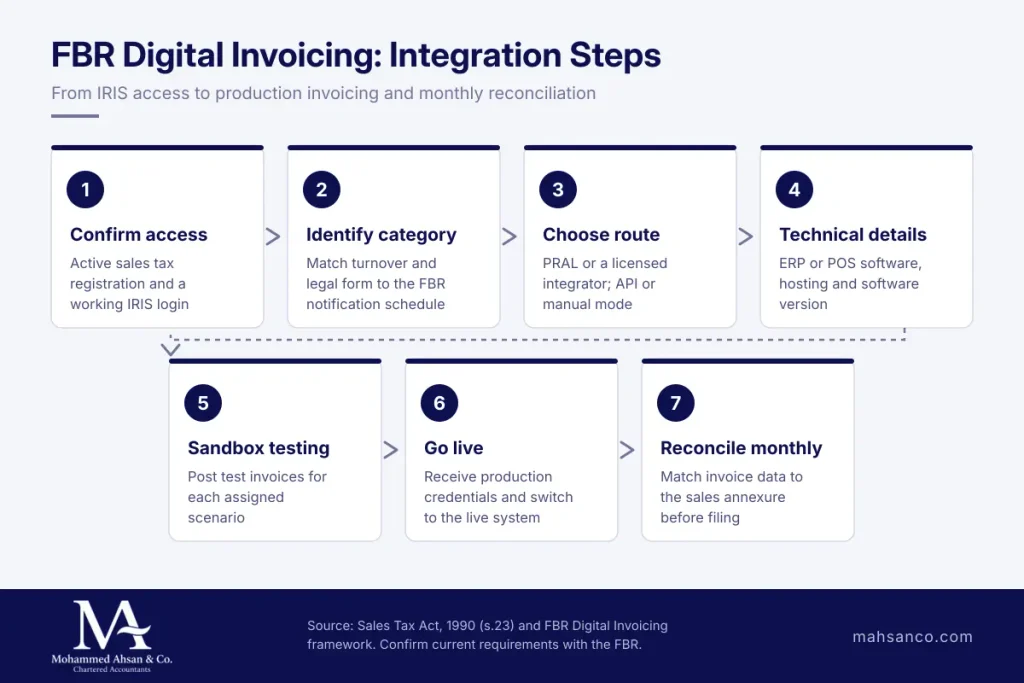
The Rules require PRAL to provide integration services free of cost on request, although you still bear the cost of your own hardware and software. Other FBR-licensed integrators may charge fees. Under the Sales Tax General Order 01 of 2026, issued on 30 March 2026, a registered person may engage one or more licensed integrators where required, which addresses the hardship of dealing with a single provider across several systems. Check an integrator’s licence status on the FBR’s official list rather than relying on a vendor’s statement.
Digital invoices cannot be changed casually. Under the General Order, an integrated person may cancel, delete or edit a valid electronic invoice only if it was generated because of a bona fide mistake, and only through the FBR’s computerised system within 72 hours of generation. After 72 hours, any cancellation, deletion or edit requires the prior approval of the concerned Commissioner Inland Revenue.
This makes pre-issue checks far more important. Pricing, tax rate, HS code and buyer details should be verified before an invoice is posted, because the correction window is short.
The penalty framework has been tightened. The Finance Act 2026 substituted entry 25 in the section 33 penalty table, and the FBR explained the changes in its Sales Tax Circular 1 of 2026. The main provisions are summarised below.
| Provision | Consequence |
|---|---|
| Section 33, S. No. 25 (as substituted by the Finance Act 2026): failure to integrate within the time notified by the Board | First penalty of up to Rs 1 million; up to Rs 5 million if the default continues one month after the first penalty; premises may be sealed, with or without a penalty |
| Section 33, S. No. 25A: failure to integrate or to issue electronic invoices after integration | Reported as Rs 500,000 for a first default, rising for repeat defaults up to Rs 3 million |
| Section 21(2): suspension of registration | Non-compliance with section 23(5) and (6) is now a listed ground for suspension |
Two cautions apply. First, entries 25 and 25A overlap, and the Act does not make clear which one prevails in every case, so the provision invoked in a notice should be read carefully. Second, press reports in September 2026 indicated that some businesses had found their sales tax registrations suspended for non-integration, and that taxpayer groups were objecting to suspensions made without a formal notice. If your registration is suspended, the effect on input tax adjustment and refunds can be serious, so it should be addressed promptly.
Integration is not only an IT task. Because the sales annexure is built from invoice data, errors made at the point of invoicing now flow directly into the return.
Consider a hypothetical distributor whose ERP records 400 sales in a month, but 15 of those sales were invoiced manually during a system outage. The ledger and the integrated invoice data will not agree, and the gap will surface when the return is reconciled. A written outage procedure, agreed in advance, prevents this situation.
Karachi has a broad mix of importers, distributors, manufacturers and trading companies, which fall into several different categories in the schedule above. Sialkot’s manufacturers and exporters, including those in sports goods, surgical instruments and leather, often run mixed local and export sales, which makes accurate classification and reconciliation especially important. Firms in both cities benefit from a review of their invoicing workflow before a notice arrives, rather than after.
Where recurring mismatches point to weak controls, a focused internal audit review can address the cause. You can also read more about Mohammed Ahsan & Co. and our approach to compliance work.
It is mandatory for sales tax registered persons covered by the FBR’s notified schedule, and the last category under SRO 1852(I)/2025 was due to begin issuing electronic invoices by 31 December 2025. Businesses with an unusual structure should confirm their position against the notification.
Under the Rules, PRAL must provide integration services free of cost on request. Other licensed integrators may charge fees, and you are responsible for your own software and hardware.
Only in limited cases. A valid invoice generated by a bona fide mistake can be cancelled, deleted or edited through the FBR’s system within 72 hours. After that, you need prior approval from the concerned Commissioner Inland Revenue.
The federal system operates under the Sales Tax Act, 1990, which mainly covers goods. Provincial authorities administer sales tax on most services under their own laws. Some federal extensions were reported in 2026, so check the relevant notification for your activity.
You may face penalties under section 33 of the Sales Tax Act, including up to Rs 1 million for a first default and up to Rs 5 million if it continues, and premises may be sealed. Registration may also be suspended for non-compliance with section 23(5) and (6).
No. A compliant digital invoice is generated through the integrated system and carries the FBR invoice number, QR code and logo. A document prepared outside the system does not meet that requirement.
The category dates in SRO 1852(I)/2025 have all passed, and we have not confirmed any later general extension. Deadlines are set by Board notification, so check the FBR website for the notification covering your category.
FBR digital invoicing turns each sales invoice into a real-time record that the FBR can see. The main risks for businesses are late integration, invoice errors that cannot easily be corrected, and mismatches between invoice data and the sales tax return. Businesses that integrate properly, control their master data and reconcile monthly are in the strongest position under the revised penalty regime.
If you would like a review of your invoicing process or your readiness for FBR compliance, you can contact Mohammed Ahsan & Co., call or WhatsApp +92 346 8900089, or email ahsan@mahsanco.com.
A direct conversation, not a sales pitch.